
The best digital laser level is often a magnetic angle cube or inclinometer that prints degrees on a backlit screen—and sometimes a short laser to help you mark—rather than a classic self-leveling cross. Woodworkers, fabricators, and remodelers use digital readouts when bubbles are too vague for miters, ramps, and machine setup.
This 2026 roundup compares magnetic digital cubes, dual-axis inclinometers, a laser distance meter, and a green cross-line companion for wall projection. We skip prices and focus on resolution, magnets, charging, and whether you need degrees, distance, or projected lines.
If your work is half shop and half install, budget for both a digital cube and a self-leveling projector—the price of one returned wrong tool usually covers the second instrument you actually needed.
Top 3 Picks for Best Digital Laser Level
4-Side Magnetic Angle Cube + Laser

- Digital angle readout with laser assist
- Four magnetic faces for machine work
- Backlit cube built for shop setups
USB Magnetic Inclinometer + Laser

- 4.9-rated digital inclinometer experience
- Auto-rotating backlit display
- USB charging and magnetic base
0.05° Dual-Laser Digital Cube

- Fine 0.05° resolution for tight tolerances
- Dual laser assists on four-magnet body
- USB-C and IP54 for shop durability
Affiliate Disclosure: As an Amazon Associate we earn from qualifying purchases. We earn a commission, at no additional cost to you.
10 Best Digital Laser Levels Compared
Compare digital angle tools and laser meters by readout type, magnets, and assist lasers. Specs avoid prices—confirm resolution and charging on the live listing.
- Digital angle + laser
- 4-side strong magnets
- Backlit inclinometer cube
- Rechargeable digital angle
- 4-side magnets + laser
- Backlit mini cube
- ~100 ft green cross-line
- Self-level + pulse
- Tripod included
- USB digital angle + laser
- 4-side magnets; IP54
- Class 2 laser inclinometer
- 3-in-1 angle + laser
- Protractor / inclinometer
- Picture u0026 shelf alignment
- Dual laser digital gauge
- Magnetic angle cube
- Slope % + miter modes
- USB rechargeable inclinometer
- 4×90° measurement
- Auto-rotating backlit LCD
- 165 ft laser distance meter
- Area/volume/Pythagoras
- Backlit LCD; 2 bubbles
- Dual-axis MEMS + laser
- IP54; USB-C rechargeable
- Dual LCD backlight
- 0.05° resolution inclinometer
- 4-side magnets; dual lasers
- USB-C; IP54 digital level
We earn a commission, at no additional cost to you.
Detailed Product Reviews
1. 4-Side Magnetic Angle Cube + Laser
Our Editor’s Choice for the best digital laser level in the angle-cube class is this 4-side magnetic electronic finder with a laser assist—built for table saws, miters, and machine setup where a bubble lies and a number tells the truth.
- Electronic angle finder + laser
- 4-side magnetic faces
- Backlit display
- Woodworking/miter focus
- Portable cube form
- Magnets on all work faces
- Laser assists alignment
- Backlight for shops
- True digital readout
- Great table saw companion
- Not a room layout 360
- Short laser assist range
- Calibrate after drops
Four magnetic faces stick to steel fences and blades so both hands stay free. The laser is an alignment helper, not a room cross-line. Backlight keeps digits readable when the shop fluorescents are uneven.
Zero on a known reference before trusting a cut list. Cubes hate drops onto concrete—recalibrate after any bounce. For picture hanging across a wall, you still want a self-leveling cross like Motovera in this list.
Choose this cube when the best digital laser level means precise angles for woodworking. Choose Motovera when you need wall planes. Digital inclinometers and layout lasers solve different mornings.
If two digital tools disagree, stop and find the reference surface problem before you split the difference—splitting error is how good lumber becomes scrap.
Zeroing and relative angles
Absolute level and relative bevels are different modes—know which you are in before cutting expensive hardwood.
Keep magnet faces clean; sawdust packs create false tilt.
Laser assist vs layout laser
The cube’s laser aims a machine or mark. It does not wrap a kitchen. Keep both tool types if you build and install.
We earn a commission, at no additional cost to you.
2. Rechargeable Magnetic Angle + Laser

This rechargeable magnetic angle gauge targets the best digital laser level buyer tired of dead button cells mid-setup. Four-side magnets, a laser assist, and a backlit cube readout cover saws, fences, and metal layout in the shop.
- USB rechargeable pack
- 4-side magnetic gauge
- Laser alignment assist
- Backlit display
- Woodworking measuring focus
- No AA scavenger hunts
- Strong magnetic mounting
- Laser for quick references
- Compact cube carry
- Solid 4.4 rating
- Runtime varies by backlight use
- Not IP65 jobsite sealed
- Short laser range
Recharging overnight beats rattling AA drawers. Use the laser to extend a mark; use the digits for the angle that actually matters. Keep expectations shop-scale, not outdoor rotary-scale.
Wipe magnets after cutting steel. Recalibrate if the cube takes a belt-sander vacation onto the floor. Backlight is a battery tax—dim it when you can.
Pick rechargeable when convenience defines your best digital laser level. Pick higher-precision 0.05° class cubes when tolerance is tighter. Pick Motovera when walls, not blades, are the work.
If two digital tools disagree, stop and find the reference surface problem before you split the difference—splitting error is how good lumber becomes scrap.
Charge habits
Top off before long millwork days. A cube that dies mid-bevel wastes more money than the charger cable ever cost.
Shop vs remodel use
Excellent on machines; awkward as a sole wall layout tool. Pair with a cross-line for installs.
We earn a commission, at no additional cost to you.
3. Motovera Green Cross + Tripod

Motovera earns a slot in a best digital laser level guide as the layout companion: when your digital cube sets a bevel, you still need a self-leveling green cross to place that work on walls and cabinets.
- Self-leveling green cross
- 4 brightness + pulse
- Manual + self-level modes
- IP54 body
- Aluminum tripod in kit
- True wall layout capability
- Tripod for open rooms
- Green visibility
- Complements angle cubes
- DIY-friendly kit
- Not a digital inclinometer
- Cross-line only
- Light-duty tripod
Digital angle tools measure; Motovera projects. Confusing the two categories is how keyword lists get weird and buyers get disappointed. Use Motovera for hanging, tile edges, and height lines.
Brightness steps and pulse mode extend usefulness. Tripod inclusion means fewer add-ons. It will not read 37.2° on a blade—that is the cube’s job.
Add Motovera when your digital kit needs a projection tool. Skip it if you already own a bright cross. The best digital laser level setup for remodelers is often cube + cross.
If two digital tools disagree, stop and find the reference surface problem before you split the difference—splitting error is how good lumber becomes scrap.
Cube + cross workflow
Cut with digital accuracy in the shop, install with a self-leveling line on site. Sequence beats forcing one tool.
Why projection still matters
A perfect angle on a board still sits wrong if the wall reference is crooked. Projection lasers pin that reference.
We earn a commission, at no additional cost to you.
4. XUNTOP USB Digital Angle + Laser
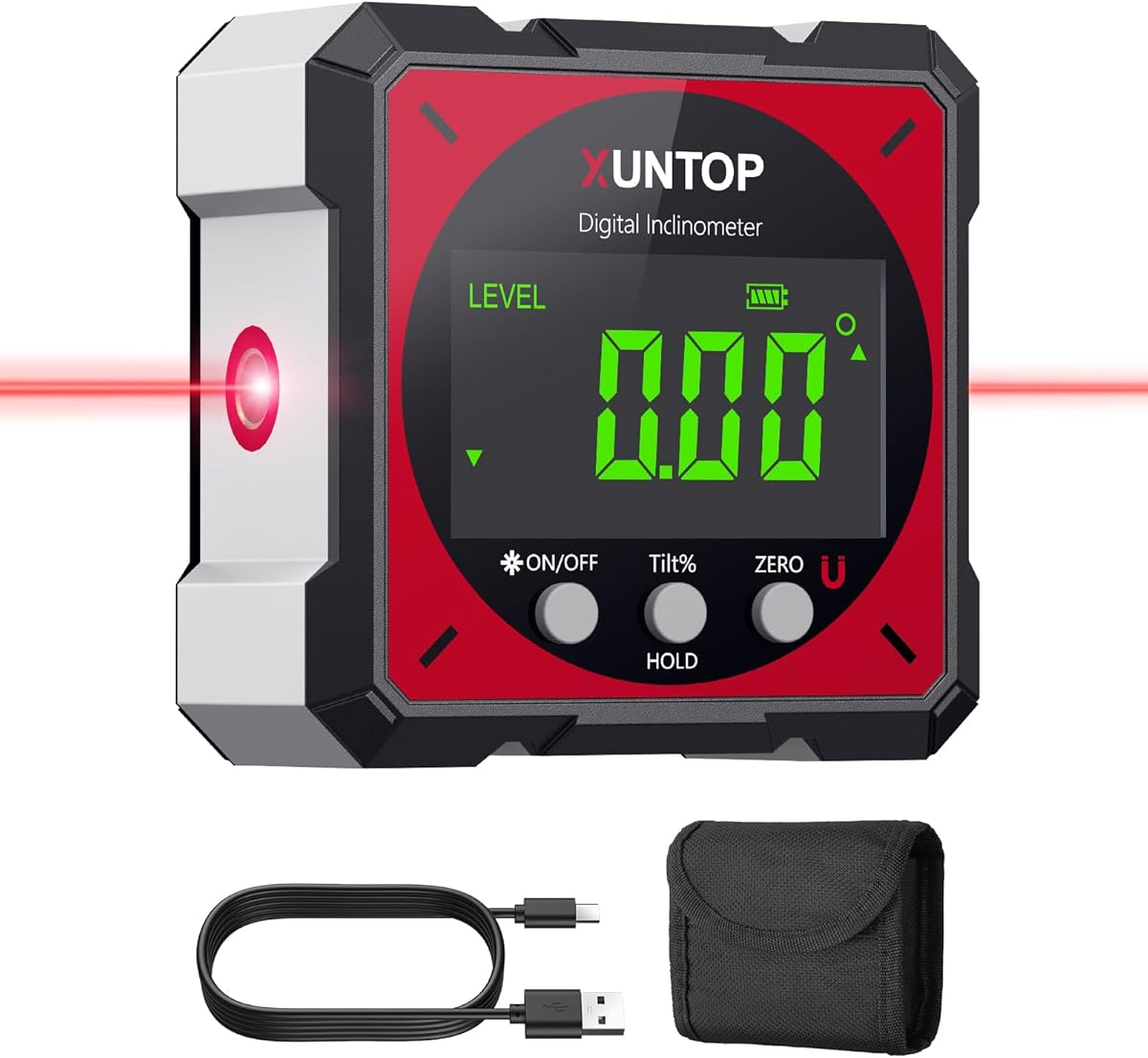
XUNTOP’s USB-charged digital angle box with laser is a shop-tough take on the best digital laser level idea: magnets on four sides, IP54 sealing, and a Class 2 laser for alignment while the screen reports angle.
- USB charging angle box
- 4-side strong magnets
- IP54 waterproof rating
- Class 2 laser u003c1 mW
- Inclinometer for machines
- IP54 for dusty shops
- USB charging convenience
- Magnetic on four sides
- Laser alignment assist
- Durable box form
- Not a long-range layout laser
- Display habits vary by unit
- Recalibrate after impacts
IP54 helps when the table saw throws dust like confetti. USB charging avoids orphan battery sizes. Use it to set blades, fences, and steel fabrications more than to hang a gallery wall.
Class 2 output is standard—still do not stare into it. Zero carefully. If numbers jump after a drop, recalibrate before the next hardwood run.
Choose XUNTOP when sealing and USB power matter in a digital angle box. Choose higher-resolution cubes when 0.05° class readouts are required. Choose a cross-line for room layout.
If two digital tools disagree, stop and find the reference surface problem before you split the difference—splitting error is how good lumber becomes scrap.
IP54 in the shop
Dust resistance helps; resin and glue still deserve wipe-downs. Keep ports capped if the design allows.
Fabrication use
Great on steel weldments with magnets. Verify with a second square on structural work that cannot be wrong.
We earn a commission, at no additional cost to you.
5. 3-in-1 Laser Angle Gauge

This 3-in-1 laser angle gauge courts the best digital laser level shopper hanging pictures, shelves, and frames who wants digital angles and a laser mark without a full pendulum cross-line kit.
- Laser alignment tool
- Digital angle/protractor modes
- DIY hang and framing focus
- Portable gauge body
- Multi-mode measuring
- Designed for hang/DIY angles
- Laser helps mark lines
- Multi-mode convenience
- Friendly for homeowners
- Bridges cube and layout
- Jack-of-all-trades limits
- Not pro rotary accuracy
- Verify critical angles twice
Protractor and inclinometer modes cover odd wall angles and stair accents. The laser helps transfer a line once the number looks right. It is a convenience bridge, not a replacement for Motovera-class self-leveling on big walls.
Homeowners like fewer tools on a Saturday. Pros may still prefer a dedicated cube plus a dedicated cross. Verify odd angles twice—phone photos of the screen help when you walk away and forget the number.
Buy the 3-in-1 when DIY hang versatility is the goal. Buy a precision cube for machine setup. Buy Fanttik/Motovera when self-leveling lines matter more than digital readouts.
If two digital tools disagree, stop and find the reference surface problem before you split the difference—splitting error is how good lumber becomes scrap.
Stair and accent angles
Hold the tool steady; digital filters can lag if you swing it like a wand.
Mark the laser lightly, then confirm with a tape on long runs.
When to graduate tools
If you install cabinets weekly, split digital measurement and projection into dedicated tools.
We earn a commission, at no additional cost to you.
6. Dual Laser Magnetic Angle Cube

Dual-laser magnetic cubes push the best digital laser level concept further for woodworkers who want lasers shooting both ways while the screen shows angle or slope percent for ramps and miters.
- Dual laser projection assist
- Magnetic electronic cube
- Slope percentage readout
- Table saw miter protractor use
- Woodworking measuring focus
- Dual lasers extend marks
- Slope percent for ramps
- Miter-friendly workflows
- Magnetic mounting
- Strong digital feature set
- More modes to mis-set
- Not a room 360 laser
- Learn the UI before hardwood
Slope percentage is handy for accessibility ramps and drainage boards. Miter modes speed saw setup. Magnets free your hands on steel fences. Spend ten minutes learning mode icons before cutting curly maple.
Dual lasers are still short assist beams. They will not square a patio. Keep a layout laser for walls. Recalibrate after drops like any MEMS inclinometer.
Choose dual-laser when mark extension and slope percent matter. Choose simpler cubes if UI sprawl slows you down. Choose Topcon-class rotaries if you meant outdoor grade all along.
If two digital tools disagree, stop and find the reference surface problem before you split the difference—splitting error is how good lumber becomes scrap.
Slope percent vs degrees
Know which unit the printout or code wants. Mixing percent and degrees is a classic expensive mistake.
Write the unit on painter’s tape next to the cut list.
UI discipline
Lock the mode before walking to the saw. Accidental toggles happen when gloves bump buttons.
We earn a commission, at no additional cost to you.
7. USB Magnetic Inclinometer + Laser
With a 4.9 rating, this USB magnetic inclinometer with laser is a leading best digital laser level style pick for people who want a clear auto-rotating display and hassle-free charging while setting angles on metal and machines.
- Magnetic digital inclinometer
- Laser assist alignment
- USB rechargeable
- Auto-rotating display
- 4×90° angle measurement
- Excellent 4.9 rating
- Auto-rotating screen
- Magnetic base convenience
- USB charging
- Clear backlit LCD
- Still shop-scale laser range
- Not a pendulum room laser
- Protect from concrete drops
Auto-rotate screens matter when you flip the cube mid-setup. Magnets hold; laser assists; digits decide. It will not replace a self-leveling cross for hanging a full gallery—but it will set the bevel that gallery frame needs.
Treat the rating as earned convenience, not immortality. Recalibrate after impacts. Keep the display clean so auto-rotate sensors and windows stay honest.
Pick this when rating and display ergonomics lead your best digital laser level decision. Pick 0.05° resolution models when tolerance is tighter. Pair with a layout laser for walls.
If two digital tools disagree, stop and find the reference surface problem before you split the difference—splitting error is how good lumber becomes scrap.
Auto-rotating displays
Let the screen settle after a flip before writing the number down.
Avoid covering sensor zones with tape labels.
Why ratings spike on these tools
When a digital cube just works, reviews glow. When it drifts after drops, reviews punish—handle yours like an instrument.
We earn a commission, at no additional cost to you.
8. RockSeed 165ft Laser Measure

RockSeed’s laser measure enters a best digital laser level roundup because many shoppers mean ‘digital laser measuring tool’ as much as inclinometer. It returns distance, area, and volume on a backlit LCD out to roughly 165 feet.
- 50 m / 165 ft measure
- Area, volume, continuous
- Pythagorean functions
- Backlit LCD; mute mode
- IP54; unit switching
- True digital distance readout
- Rich measuring modes
- IP54 pocket meter
- Bubbles for rough aim
- Different job than angle cubes
- Not an angle inclinometer
- Not a room layout plane
- Needs reflective discipline
Two bubble vials help rough aim. Mute mode saves courtesy in quiet homes. IP54 suits dusty remodel pockets. It will not draw a level line across a wall—that is a different laser.
Hold on target, watch units, and mind glossy surfaces that bounce weird. Pythagoras modes help when you cannot place the meter at a point—practice before trusting a stair stringer calculation.
Buy RockSeed when digital distance is the job. Buy angle cubes when degrees matter. Buy Motovera when projection lines matter. Keyword overlap should not force the wrong instrument into your cart.
If two digital tools disagree, stop and find the reference surface problem before you split the difference—splitting error is how good lumber becomes scrap.
Measuring discipline
Same start point every time. Moving the rear reference between shots invents false lengths.
Record units on the cut list—meters vs feet has ruined more IKEA days than bad blades.
When a measure beats a layout laser
Estimating flooring and HVAC openings loves a distance meter. Setting cabinet reveals loves a cross-line. Own the distinction.
We earn a commission, at no additional cost to you.
9. eSynic Dual-Axis Laser Inclinometer

eSynic’s dual-axis digital inclinometer with laser is for the best digital laser level buyer who needs X and Y tilt at once—machine leveling, platform setup, and fabrication—plus a laser line assist and USB-C charging in an IP54 body.
- Dual-axis ±0.2° class
- Integrated Class II laser
- IP54 aluminum body
- USB-C rechargeable
- Dual LCD displays
- Xu0026Y axis readouts
- Laser line assist
- USB-C modern charging
- IP54 sealing
- Aluminum durability
- Learning curve on dual axis
- Not a 360 layout tool
- Calibrate after abuse
Dual MEMS sensors shine when a single-axis cube forces you to flip constantly. Dual LCDs help read from different stances. Aluminum feels like a tool, not a toy.
Accuracy around ±0.2° with fine resolution is strong for many shop tasks. Still verify critical alignments. Laser lines are short assists. For outdoor grade planes, you want a rotary, not this box.
Choose eSynic when dual-axis workflow defines the day. Choose simpler cubes for basic bevels. Choose rotaries for site grading. Match the instrument to the dimension you actually control.
If two digital tools disagree, stop and find the reference surface problem before you split the difference—splitting error is how good lumber becomes scrap.
Dual-axis setup tips
Zero both axes on a known reference plate. Do not zero on a wobbly cart and invent a fantasy level.
Watch for magnetic interference near big motors if readings act strange.
Platform and machinery use
Great for leveling stands and equipment feet. Mark each foot’s shims so you do not chase your own adjustments.
We earn a commission, at no additional cost to you.
10. 05° Precision Angle + Dual Laser
When the best digital laser level must resolve tiny angle changes, this 0.05° resolution magnetic cube with dual lasers and USB-C charging is the precision pick for woodworking and fabrication tolerances that punish guesswork.
- 0.05° resolution; ±0.2° acc.
- Dual red laser lines
- 4-side rare-earth magnets
- USB-C; ~7 hr claim
- IP54 Class II lasers
- Fine resolution for precision work
- Dual lasers extend marks
- Four-side magnets
- USB-C convenience
- IP54 shop sealing
- Premium precision may be overkill
- Short laser assist range
- Needs careful calibration habits
Four-side magnets and dual Class II lines help transfer references across a blade or fence. IP54 sealing suits shops. Runtime claims around seven hours cover long millwork days if backlight use is sane.
High resolution does not excuse a dirty reference surface. Zero often. Recalibrate after drops. Use dual lasers as short assists, not as patio layout tools.
Choose 0.05° class when tolerance pays the bills. Choose simpler cubes for rough DIY. Choose Motovera or a 360 laser when the problem is walls, not degrees.
If two digital tools disagree, stop and find the reference surface problem before you split the difference—splitting error is how good lumber becomes scrap.
Resolution vs accuracy
Resolution is the finest step shown; accuracy is how true that number is. Respect both specs on the listing.
Do not chase the last 0.05° on a painted uneven fence—fix the surface first.
Dual laser alignment
Confirm both diodes agree with a straightedge occasionally. If one drifts after impact, stop trusting it for paid work until checked.
We earn a commission, at no additional cost to you.
Buying Guide — How to Choose the Best Digital Laser Level
Digital laser shopping confuses categories. Decide whether you need degrees, distance, or projected level lines before you fall for a keyword mashup.
Angle cube vs layout laser vs distance meter
Cubes measure tilt. Layout lasers project lines. Distance meters measure length. The best digital laser level for you depends on which verb you need.
Buying the wrong verb is the most common return reason in this keyword.
Resolution and accuracy
0.05° resolution helps precision millwork; ±0.2° accuracy class is common. Resolution is not accuracy—read both.
Recalibrate after drops; MEMS sensors remember abuse.
Magnets and workholding
Four-side magnets transform cubes into third-hand tools on steel. Weak magnets create fake numbers.
Keep chips off faces.
Power: USB-C vs batteries
USB-C suits shops with cords. Batteries suit remote sites. Backlights drain either.
Charge the night before bevel-heavy days.
Laser assists vs real layout lasers
Short cube lasers mark near-field references. Room layout needs self-leveling crosses or 360 planes.
Own both if you build and install.
IP sealing and durability
IP54 helps in dusty shops. None of these replace rotary IP66 site lasers for grading.
Treat cubes like instruments, not hammer substitutes.
Units and documentation
Degrees, percent, mm/m—pick one language per job and write it on the cut list. Mixed units create confident mistakes.
Photograph the screen for complex assemblies so you can recreate settings later.
How to Use a Digital Angle Laser Level
Clean magnet faces and the reference surface. Power on, zero to a known flat if required, and select degrees or percent intentionally.
Seat the cube magnetically or hold it steady. Let the reading settle before you cut. Use the assist laser only after the number is stable.
Recalibrate after impacts, store with ports clean, and keep a layout laser for walls when projection—not degrees—is the real task.
Frequently Asked Questions
What is the best digital laser level for woodworking?
A 4-side magnetic angle cube with laser assist is our Editor’s Choice. High-rated USB inclinometers and 0.05° precision cubes are excellent upgrades for tighter tolerances.
Is a digital angle finder a laser level?
It can include a laser assist, but it primarily measures angles. A self-leveling cross-line is a different tool for projecting level lines on walls.
Do I need dual-axis?
Dual-axis helps when leveling platforms or machines in two directions at once. Single-axis cubes are enough for many bevels.
What about laser distance meters?
They are digital laser measuring tools for length/area/volume, not inclinometers. Buy them for estimating and layout distances.
How often should I calibrate?
After drops, temperature shocks, or any time readings disagree with a known reference. Follow the manufacturer’s zero/cal procedure.
Can these replace a rotary laser?
No. Rotaries create site-wide planes with detectors. Digital cubes measure local angles.
Are magnets safe near electronics?
Keep strong magnets away from sensitive cards and some electronics. On steel fences and blades they are the feature, not a bug.
Which digital tool is best overall here?
The 4-side magnetic angle cube is our Editor’s Choice for most shop users. The 4.9-rated USB inclinometer wins ergonomics. The 0.05° cube wins precision.
Final Thoughts on Choosing the Best Digital Laser Level
For most shop users, a 4-side magnetic digital angle cube with laser assist is the best digital laser level starting point in this guide. High-rated USB inclinometers win display ergonomics, and 0.05° cubes win tight tolerances.
Keep categories straight: degrees, distance, and projected lines are different jobs. Confirm resolution and charging on the listing, and replace YOURTAG-20 before publishing.
Start with the Top 3, then add a self-leveling cross if you install what you build—the combination is how digital accuracy survives the trip from shop to wall.