
A green laser level is one of those tools that makes a room feel smaller in the best way: a shelf wall becomes a single horizontal decision, a cabinet run becomes a repeatable datum, and a tile layout stops depending on pencil marks that vanish under thinset. The catch is that “green” is often marketed as if it solves every visibility problem. It does not. Green lines are usually easier for our eyes to pick out indoors, especially against pale walls and under ordinary work lights, but direct sun can wash out a green beam just as decisively as a red one.
This guide focuses on the best green laser level for real indoor visibility, while separating that advantage from the outdoor myth. We compared ten self-leveling green-beam tools for the jobs people actually do: hanging and trim work, backsplashes, cabinetry, electrical layout, whole-room tile, and brighter-site work with a receiver. The result is not a single universal winner. A compact cross-line model can be the right answer for a homeowner, while a three-plane tool earns its keep when moving the laser would interrupt a cabinet or ceiling layout.
Ratings below reflect the supplied marketplace data and are useful context rather than laboratory scores. We did not treat an advertised visible range as a promise for every room, and we did not call a tool “outdoor capable” merely because it projects green. Read the Top 3, compare the no-price table, then use the buying guide to decide which combination of planes, power source, mount, and receiver support fits your work.
Top 3 Green Laser Levels
CIGMAN 3×360° Green Laser Level

- Three green 360-degree planes reduce repositioning in multi-wall rooms
- Rechargeable power, remote, and magnetic rotating stand support deliberate layout work
- Best fit for tile, cabinets, ceiling references, and remodelers who use planes often
Fanttik D2 Pocket Green Laser

- Small cross-line tool with a rotating magnetic bracket and USB-C charging
- Up to 10-hour claimed runtime makes it easy to keep ready for small projects
- A practical choice when visibility matters more than full-room plane coverage
DEWALT DW088CG Green Cross Line Laser

- Durable overmolded housing, integrated magnetic bracket, and IP54 protection
- Full-time pulse mode makes detector use less cumbersome when conditions demand it
- The sensible pro choice for users who need a durable reference, not extra planes
Affiliate Disclosure: As an Amazon Associate we earn from qualifying purchases. We earn a commission, at no additional cost to you.
10 Best Green Laser Levels Compared
There are no prices in this table because bundles and availability change. Instead, compare the things that continue to matter after checkout: the projected geometry, how the tool is powered, and the feature that makes it more useful on your kind of job.
- Green horizontal and vertical cross lines
- Self-level, manual, pulse, four brightness settings
- Tripod included; IP54 body
- Three 360-degree green planes
- Rechargeable, 6+ hour claimed runtime
- Compact magnetic-mount body; IP54
- Three 360-degree green planes
- Rechargeable battery, remote, rotating stand
- Pulse mode for compatible receiver use
- Green cross line with 100ft indoor claim
- Self-level, manual, pulse modes
- Magnetic bracket for quick positioning
- Pocket-size green cross-line laser
- USB-C rechargeable 2200mAh battery
- 360-degree rotating magnetic bracket
- Green cross-line laser; 50ft stated range
- AA cells or optional Bosch Li-ion pack
- IP55 protection and integrated magnetic mount
- Green cross line; 100ft visible-range claim
- Full-time pulse mode
- IP54 housing, magnetic bracket, AA power
- Green cross line plus plumb spot
- 75ft stated working range
- Magnetic mount and 2×4/metal-track base cutout
- Green cross-line laser
- Manual and self-leveling modes; AA power
- 50-inch tripod and pouch included
- 110-degree green cross line
- Self-leveling pendulum; two AA batteries
- IP54-rated body and carry bag
We earn a commission, at no additional cost to you.
Detailed Product Reviews
1. Motovera 100ft Green Cross Line

The Motovera makes the most sense for the person starting a run of household projects rather than for a contractor replacing a dedicated layout system. Its green cross is more forgiving to see than a comparable red line in a daylight-filled kitchen or under bright LED cans, and the included tripod matters because a laser at the wrong height is no help. Four.
- Green cross line with 110-degree projection angle
- Claimed ±1/9 inch at 33ft
- Self-leveling, manual, and pulse modes
- Four brightness modes
- Tripod and carry case included
- A usable out-of-box kit for first projects
- Brightness control is helpful in changing rooms
- Tripod avoids an immediate accessory purchase
- Pulse mode leaves a receiver upgrade path
- The supplied tripod is convenience-grade
- Cross lines cannot replace full 360-degree planes
- A lower rating than several established-brand picks
The important distinction is between contrast and distance. A stated 100-foot indoor range is not a guarantee that you will see a razor-thin line across every sunlit great room. White gloss paint, windows behind you, and dusty air all affect the view. For hanging a picture series, setting a chair rail, or establishing a backsplash start, the Motovera.
Self-leveling works within the stated tilt window; a continuously flashing line tells you the base is too far out, not that the tool has failed. Lock the pendulum before carrying it, confirm that the tripod is firmly planted, and do a quick reversal check against two wall marks before critical work. Pulse mode.
Who should choose the Motovera?
Choose it if you need a green-beam cross-line laser, a basic tripod, and an uncomplicated learning curve in one box. Skip it if full-room tile or cabinetry is a weekly task.
We earn a commission, at no additional cost to you.
2. Klein Tools 93CPLG

The Klein 93CPLG is the compact answer for someone who has outgrown a cross-line laser but does not want a giant case in the truck. Three 360-degree green planes create a horizontal reference plus vertical planes around the room, so a cabinet line can continue through a corner and a ceiling reference can remain available while you work. That.
- Three bright green 360-degree planes
- Up to 100ft stated projection range
- Rechargeable; 6+ hour runtime claim
- Tilt mode and magnetic mount
- IP54 overmolded housing
- Three planes from a compact body
- Familiar trade-tool brand
- Rechargeable power avoids constant AA changes
- Magnetic setup is fast on metal surfaces
- No tripod in the listed base package
- More tool than a picture-hanging job needs
- IP54 is not the same as high-sealing jobsite protection
Klein claims its green planes are up to twice as bright as standard red beams. Treat that as an indoor visibility benefit, particularly on framing, drywall, and painted walls, rather than as an outdoor range claim. The rechargeable runtime is a better fit for repeat work than a model that needs fresh cells every few days. The.
The tradeoff is that the package is less of a turnkey bundle than tripod-included alternatives. Plan for a solid stand when there is no metal to grab, and remember that the more planes you turn on, the more battery demand you create. A compact three-plane green laser is excellent for interior layout; it remains a poor substitute for a detector-and-receiver workflow outside.
Why the 360-degree planes matter
They let you transfer a reference around the room without shifting the tool, which is particularly valuable when cabinets, partitions, and ceiling features must agree.
We earn a commission, at no additional cost to you.
3. CIGMAN 3×360°
For interior renovation, the CIGMAN 3×360° is our best overall green laser level because its planes solve the most common layout frustrations without making the kit feel specialized. One horizontal plane can ride near the floor for tile or baseboard work, another can be used at ceiling level, and the vertical planes give you a square reference.
- Twelve green lines across three 360-degree planes
- Self-leveling, manual, and pulse modes
- Rechargeable battery and remote control
- Magnetic rotating stand included
- IP54 protection
- The right plane geometry for tile and cabinet work
- Remote is useful when the tool is across a room
- Includes a rotating magnetic stand
- Strong rating for a feature-rich package
- Receiver is an additional purchase
- Less weather protection than an IP65 tool
- Brand service may be less convenient than a big tool brand
Its green lines are easiest to appreciate in rooms where the red line from an older laser tends to disappear against beige paint, wood studs, or bright task lighting. The remote is genuinely practical when you are standing at the far end of a long cabinet run and want to change a plane rather than walk back.
There are boundaries. The listing’s pulse mode can extend working range when paired with the right receiver, but it may make the line appear dimmer to your eye. That is normal. It is the receiver, not the naked-eye green beam, that makes outdoor layout reliable. For interior work, use the rotating stand or a rigid.
Best use cases for CIGMAN
This is the pick for cabinet installers, tile setters, and serious DIY remodelers who benefit from keeping several level and plumb references visible simultaneously.
We earn a commission, at no additional cost to you.
4. CIGMAN 100ft Cross Line

This CIGMAN cross-line laser is the sensible middle ground between a starter kit with lots of accessories and a multi-plane renovation tool. It has the horizontal-and-vertical geometry most people use for mirrors, shelving, wall panels, and a simple tile start. The supplied magnetic bracket is the feature to notice: a good bracket often delivers more practical accuracy than.
- Green cross line; 100ft indoor listing claim
- Self-levels within ±4 degrees
- Manual and pulse modes
- Magnetic bracket
- Claimed ±1/16 inch at 16ft accuracy
- Clear mode explanations for newer users
- Compact cross-line format
- Magnetic bracket is more useful than a bare base
- Pulse mode supports future receiver use
- Not a substitute for a 360-degree layout tool
- Receiver sold separately
- Visible outdoor performance should not be assumed
The manual-mode behavior is worth understanding before you buy any self-leveling laser. With the pendulum locked, this one can project an intentionally sloped line for stairs or decorative work. The flashing reminder does not mean the instrument is malfunctioning; it means the line is no longer an automatic level reference. In normal self-level mode, a persistent flash means.
Green helps this tool earn its place in bright interiors, but it does not eliminate the need to manage the light. Pull a shade or turn off the nearest work lamp if a critical mark is hard to read. For an exterior deck or a sun-soaked addition, use pulse mode and a compatible receiver. That division of labor is why this cross-line CIGMAN.
A note on flashing lines
Out-of-level and manual-mode flashes are safety cues. Read them before marking, because the wrong assumption can turn an accurate tool into an inaccurate layout.
We earn a commission, at no additional cost to you.
5. Fanttik D2 Pocket
The Fanttik D2 earns the compact pick because it respects how home projects actually happen. A laser that is always charged, small enough to find, and quick to position is more useful than a feature-heavy model that stays in a case. At roughly pocket-tool scale, the D2 is suited to gallery walls, curtain hardware, floating shelves, and the sort of one-evening upgrade where.
- Green cross line; 100ft stated indoor range
- 2200mAh integrated rechargeable battery
- Up to 10-hour runtime claim
- 360-degree rotating magnetic bracket
- USB-C charging and pulse mode
- Very easy to keep in a drawer or small tool bag
- Long claimed runtime for its size
- Rotating bracket makes alignment less fiddly
- USB-C is convenient for home use
- Only projects cross lines
- Integrated battery is less field-swappable than AAs
- No tripod included
Its green cross line is claimed to be four times brighter than red under the same light source, a common shorthand that needs context. Human vision is more sensitive to green wavelengths, so green usually appears brighter indoors at equivalent output. It does not mean four times the usable distance in every room, nor does it imply a green diode is automatically more.
The 360-degree rotating magnetic bracket is the D2’s quiet advantage. Fine height and angle changes are easier when the body can rotate without moving the contact point. The integrated battery and USB-C charging are excellent for casual users, although a crew working far from power may prefer replaceable cells or a spare pack. Buy it for responsive.
Best projects for the D2
Use it for frames, shelves, closet organizers, decorative battens, and single-wall tile starts where a bright, portable cross is more valuable than multiple planes.
We earn a commission, at no additional cost to you.
6. Bosch GLL50-20G

Bosch’s GLL50-20G is a clear choice for buyers who care as much about a durable, predictable platform as they do about a green line. It is a basic cross-line laser, intentionally so: fewer plane controls mean less setup complexity when the job is setting a row of boxes, a ledger line, or.
- Green cross-line beam; 50ft stated range
- Claimed 5/16 inch at 30ft accuracy
- Smart Pendulum self-leveling system
- IP55 dust and water protection
- AA batteries or optional Bosch Li-ion pack
- IP55 is reassuring around dust and occasional rain
- AA or optional pack gives useful power flexibility
- Integrated magnetic mount
- Compact, established-brand tool
- 50ft class is not for huge interiors
- No 360-degree planes
- Optional battery pack is an extra purchase
The IP55 rating is meaningful in context. It indicates better dust and water resistance than the IP54 tools common in light DIY kits, but it is not a license to hose the laser down or leave it on a wet slab. For remodeling, where drywall dust, splashes, and the occasional open doorway are part of the day, that added protection.
Power flexibility is another unusually mature feature. AA cells are easy to replace in the field; the optional 3.7V Bosch pack may be neater for frequent use. The limited stated range and cross-line-only pattern keep it from being our all-room winner, but that restraint is part of the appeal. If you need a green reference that feels like a durable hand tool.
Green vs. red Bosch models
Choose the green GLL50-20G when indoor contrast is a recurring problem. Choose a red version only when controlled light and lower initial tool cost outweigh the visibility advantage.
We earn a commission, at no additional cost to you.
7. DEWALT DW088CG
The DEWALT DW088CG is the review’s tough cross-line recommendation because it favors a durable core tool over extra line geometry. It projects a horizontal and vertical green reference, has an integrated magnetic bracket, and is rated IP54 for water and debris resistance. That combination is credible for a finish carpenter, electrician, or remodeler who uses a laser often.
- Green cross-line beam; 100ft visible-range claim
- ±1/8 inch at 30ft accuracy claim
- Full-time pulse mode
- IP54 water and debris resistance
- Integrated magnetic bracket and 1/4-20 mount
- Overmolded housing and stated one-meter drop rating
- Pulse mode is always ready
- Magnetic bracket integrates cleanly into a work setup
- DEWALT service ecosystem
- Cross-line format is limiting for multi-wall layout
- Detector is sold separately
- AA power is less elegant for a high-use crew
Full-time pulse mode is particularly useful. On many budget lasers, pulse requires a sequence of button presses at the moment you discover the line has disappeared in glare. DEWALT keeps the detector-oriented mode available as part of its normal workflow, though you still need the compatible detector to gain a reliable outdoor working range. The advertised 300-foot detector range is.
Green is the correct color for this tool’s primary job: quick, readable interior references under mixed jobsite lighting. However, beam visibility and battery draw are connected. Green laser assemblies generally need more electrical energy than comparable red designs to create their apparent brightness, so long sessions on AA cells deserve a spare set. That is not a.
Why power draw belongs in the decision
A brighter-looking green line can use batteries faster than a red line. For frequent work, keep spare AAs or choose a rechargeable platform with a realistic runtime plan.
We earn a commission, at no additional cost to you.
8. Klein Tools 93MCLPG

A plumb spot is a narrow feature until you need one, then it can save a surprising amount of measuring. The Klein 93MCLPG combines a green cross line with a point for transferring a location vertically, which is helpful for electrical boxes, light locations, penetrations, and any layout that needs the ceiling and floor to agree. It is more purposeful.
- Green cross line with plumb spot
- Up to 75ft stated range
- Class 2 output below 1mW
- Magnetic mount
- Base cutout for 2×4s and metal track
- Plumb point adds a useful layout function
- Compact form fits closets and service spaces
- Direct positioning on common framing materials
- Bright green lines for interior work
- Not a three-plane laser
- Shorter stated range than 100ft models
- No claim that it defeats sunlight
The base cutout deserves attention from electricians and framers. Being able to set the tool directly on a 2×4 or metal track can remove the need for a tripod on certain jobs, reducing both setup time and the chance that a loosely extended tripod gets bumped. The magnetic mount offers another fast route to the right height. Like every magnetic setup, it.
Class 2, sub-1mW specifications describe the laser classification and output limit, not a guarantee of visibility. The green line should remain easier to discriminate indoors than a red equivalent, but an exterior application still needs a receiver workflow. Choose this Klein when transferring points is the daily pain point. If you are tiling an entire room, a three-plane model is the more natural solution.
When a plumb spot beats extra planes
Pick it for point transfer between floor and ceiling, especially in electrical and fixture layout. Pick 3×360° instead for continuous room-wide reference lines.
We earn a commission, at no additional cost to you.
9. Lusweimi Green Cross Line

The Lusweimi package is for the shopper who recognizes that placement is half the job. A 50-inch tripod lets you put the green cross at cabinet height, on a picture-hanging datum, or above a floor layout without improvising a stack of boxes. That practical advantage often matters more than comparing two nearly identical visible-range.
- Green horizontal and vertical cross lines
- Self-leveling within ±4 degrees
- Manual locked-pendulum mode
- 50-inch tripod with 1/4-20 mount
- Four AA batteries and pouch
- Tripod provides immediate height control
- Replaceable AA batteries are simple
- Manual mode accommodates intentional angles
- Useful package for occasional room projects
- Tripod should not be mistaken for a survey stand
- Cross lines only
- Marketing claims about green efficiency vary by design
It uses replaceable AA batteries, a sensible choice for an occasional user who does not want to think about charging cycles between projects. The listing makes broad claims about green brightness and energy consumption; those should be treated cautiously because diode efficiency, line settings, and battery type all affect runtime. In general, green is chosen for its perceived brightness indoors, while.
Use this tool for pictures, wall features, straightforward renovation marks, and sloped applications in manual mode. The tripod is a benefit, but it needs to stand on a firm surface with its legs spread and its head tightened. A wobbly tripod can make a perfectly self-leveled line appear unreliable. For frequent precision work, upgrade the support before blaming the laser.
Tripod setup advice
Set the legs wide, lock all extensions, and avoid resting a hand on the stand while marking. A laser’s accuracy is only useful when its mount stays still.
We earn a commission, at no additional cost to you.
10. Nikotek Green Cross Line
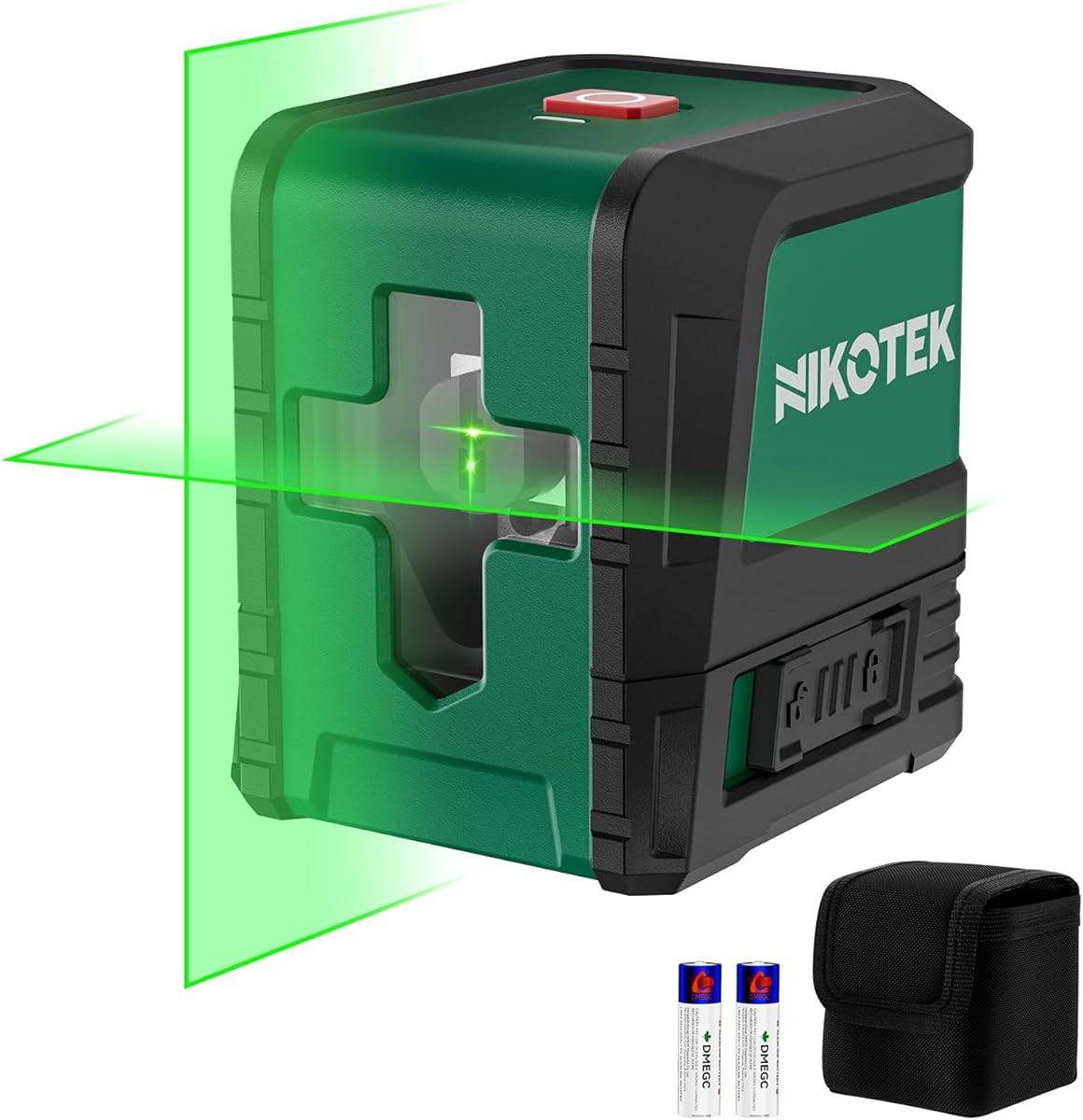
The Nikotek is the uncomplicated green laser level for occasional tasks: unlock or switch it on, give it a stable surface, and use the horizontal and vertical cross to keep a small project honest. Its broad 110-degree projection angle helps the line spread across a typical wall without requiring you to place the tool far away. For.
- 110-degree green cross line
- Self-levels within 3.5 degrees
- Class 2, below 1mW listing
- IP54 dust, water, and shock resistance claim
- Two AA batteries and carry bag
- Simple slide-on operation
- Replaceable batteries are widely available
- Wide cross-line angle for small rooms
- Straightforward option for infrequent use
- No pulse-mode feature is listed
- No tripod or advanced mount in the stated package
- Not intended for whole-room or daylight layout
It self-levels within a stated 3.5-degree range and flashes when the base is too far out. As with the other compact tools here, the green beam is an indoor visibility advantage, not an outdoor claim. The two AA batteries are a good match for an item that may wait in a closet for months: they are easy to replace and.
There is no listed pulse mode, so this is not the model to buy with plans for detector-assisted exterior work. There is also no reason to force it into professional tile layout when its purpose is simple reference work. Check its accuracy after a drop or a long move, keep the laser window.
Who should keep it simple?
Choose the Nikotek if shelves, frames, and small repairs are your normal use. Spend more only when extra planes, a better mount, a tripod, or receiver compatibility will genuinely save time.
We earn a commission, at no additional cost to you.
Buying Guide: How to Choose the Best Green Laser Level
The right green laser level is not necessarily the brightest-looking one in a product photo. Start with the references you need to create, then decide how much indoor contrast, battery capacity, mounting flexibility, and environmental protection those references require.
Green is more visible indoors—not magical outdoors
The useful green-versus-red claim is about human vision. In comparable conditions, our eyes tend to perceive green light as brighter, so a green beam is often easier to distinguish in a bright kitchen, a pale room, or a space lit by work lights. That can make marking faster and reduce the temptation to squint at a fuzzy red line.
The misleading claim is that green automatically wins outside. Sunlight contains huge amounts of light across the visible spectrum and can overwhelm either beam color. A target card, shade, or green glasses may help you locate a line, but a compatible receiver operating in pulse mode is the dependable answer for exterior layout. Compare receiver range separately from naked-eye visible range.
Choose cross lines, 3×360°, or a plumb point by workflow
A cross-line laser projects one horizontal and one vertical reference. It is perfect for shelves, picture groupings, a backsplash start, and simple wall work. It is also the most portable and usually the least demanding on battery power.
A 3×360° green laser creates a horizontal plane and vertical planes that continue around the room. Buy it when you routinely reposition a cross-line laser while installing cabinets, tile, soffits, or partitions. A plumb-spot model is more specialized: it transfers a point from floor to ceiling and is useful for fixtures, electrical, and penetrations.
Read range claims with discipline
Listings use several different range concepts: visible indoor range, detector-assisted working range, and sometimes the theoretical maximum under favorable light. They are not interchangeable. A 100-foot indoor claim can be completely reasonable for a dim-to-moderately-lit room and still be hard to see across a bright open space.
For precision layout, accuracy is more important than the largest number on the listing. Look for a clear accuracy figure at a stated distance, then field-check the unit. Put it near one wall, mark the line on an opposite wall, rotate it 180 degrees, and compare. The marks should agree within the tool’s tolerance.
Plan for the green-beam power tradeoff
Green laser systems can draw more power than comparable red-beam tools. The exact difference depends on the diode, optics, brightness setting, number of active planes, and battery chemistry, so do not rely on blanket claims that green uses less energy. A three-plane laser running all lines is simply a more demanding load than a single cross line.
AA cells are convenient for occasional users and remote sites. USB-C rechargeable tools are convenient at home. Replaceable battery packs make the most sense for professional use. Whatever you choose, judge runtime with the brightest setting and the number of planes you actually leave on—not the most flattering claim.
Mounting and stability are accuracy features
A laser cannot compensate for a mount that shifts after self-leveling. Magnetic brackets are fast on steel studs and track; a quality tripod is essential in open rooms; and a wall clamp can solve awkward height problems. Check the thread size before assuming an existing tripod will fit.
Put the tool near the work height, lock the stand, let the pendulum settle, and avoid bumping it while you mark. If a line seems to wander, inspect the support first. Most practical layout errors begin with setup, not with an optical calibration failure.
How to Use a Green Laser Level Accurately
Start with a stable location. Use a tripod on a solid floor, a fully seated magnetic bracket on steel, or a rigid ledge. Position the laser close to the height of the work you are setting out; this makes the line easier to see and reduces parallax when you transfer marks.
Unlock the pendulum or select self-level mode, then wait for the line to settle. If it flashes, adjust the base until the warning stops. Do not mark from a flashing line unless you intentionally selected manual or tilt mode for a slope. For cabinets and tile, mark a few reliable points and connect or reference them as needed rather than repeatedly leaning over the active beam.
Frequently Asked Questions
Is a green laser level always better than a red laser level?
No. Green is usually easier to see indoors because our eyes respond strongly to green wavelengths, but red can still be accurate, durable, and adequate in controlled light. Green does not automatically provide better calibration, build quality, or outdoor visibility.
Can I see a green laser level outside in sunlight?
Sometimes at short range or with shade, but you should not plan a job around naked-eye visibility in direct sun. Use pulse mode and a compatible receiver for reliable exterior range. A target card or glasses may help locate the line but do not replace a receiver.
Why does my green laser level use batteries quickly?
Green laser assemblies can require more energy than comparable red ones, and active 360-degree planes increase demand further. High brightness settings, cold weather, older batteries, and using several lines at once also reduce runtime. Carry spares or use a model with a replaceable rechargeable pack.
What is the best green laser level for hanging pictures?
A compact cross-line model such as the Fanttik D2, Motovera, Bosch GLL50-20G, or Nikotek is usually enough. You need a stable mount and a readable horizontal line, not three 360-degree planes. A small tripod or rotating bracket is often more useful than extra features.
Do I need a 3×360° green laser level for tile?
Not for every small backsplash, but it is valuable for floors, showers, and multi-wall rooms. The extra planes let you keep horizontal and plumb references running without moving the tool. For recurring tile or cabinet work, that convenience can save substantial time.
What does pulse mode do?
Pulse mode changes the laser signal so a compatible receiver can detect it at longer working distances or in brighter conditions. On some tools the line may look dimmer in pulse mode. It is intended for detector-assisted work, not for making the bare beam magically visible in sunshine.
Final Verdict: Pick Green for Indoor Contrast, Not Outdoor Hype
For most serious indoor layout, the CIGMAN 3×360° is the best green laser level in this guide because it offers the plane coverage that cabinetry, tile, and multi-wall renovation actually require. The Fanttik D2 is the better small-tool choice for household tasks, while the DEWALT DW088CG is the durable cross-line option for trade users who value a tough, uncomplicated reference.
Green is worth paying for when a clearer indoor line helps you work accurately. Do not pay for it expecting the sun to disappear or assuming the most visible beam will also have the best runtime. Select the geometry you need, mount the tool firmly, account for power draw, and add a compatible receiver when outdoor work is real rather than hypothetical.