
Finish carpentry punishes small layout mistakes. A door casing that drifts a sixteenth over the height of a jamb reads as a shadow line. A run of upper cabinets that starts level and ends high against the ceiling looks worse than an unfinished wall. The best laser level for carpenters is not a grading rotary or a novelty picture hanger. It is a self-leveling reference you can trust while hanging doors, setting cabinet ledgers, snapping chair-rail height, plumbing tall built-ins, and checking stair stringer angles without walking a spirit level around every elevation.
This roundup focuses on finish carpentry layout and the shop work that surrounds it. We compared ten tools that carpenters actually reach for: bright green cross-line lasers for trim and casing, compact 360-degree planes for multi-wall cabinet installs, durable jobsite red beams that survive a dusty remodel van, and magnetic digital angle finders that help when a laser line alone does not answer a miter or blade question. Whether you are shopping for the best laser level for finish carpentry or a tougher kit for framing-to-finish crews, start with the Top 3, scan the comparison table, then read the reviews for honest fit—not a feature checklist copied from a listing.
Top 3 Laser Levels for Carpenters
Klein Tools 93CPLG Compact 360°

- Three bright green 360° planes for cabinets, trim, and built-ins
- Compact magnetic body that fits tight closets and pantry installs
- Rechargeable runtime suited to full finish days
DEWALT DW088K Cross-Line

- Overmolded housing with a real drop rating and hard case
- Integrated magnetic bracket for steel track and door bucks
- Detector-ready range when exterior openings need a longer pull
Fanttik D2 Pocket Green Laser

- Bright green cross lines for casing, shelves, and punch-list trim
- USB-C rechargeable pocket body with rotating magnetic bracket
- Self-level, manual, and pulse modes without a bulky kit
Affiliate Disclosure: As an Amazon Associate we earn from qualifying purchases. We earn a commission at no additional cost to you.
10 Best Laser Levels for Carpenters Compared
Live listings and bundles change often, so this table skips cost figures. Compare layout format, mounting style, and what each tool is actually good for on a carpentry day—cabinet ledger lines, door plumbing, trim height, stair angles, or shop setup—then confirm battery type and included accessories on the live product page.
- Green cross line; ~100 ft indoor
- Self-level, manual, pulse modes
- Aluminum tripod included
- Red cross line; ~50 ft
- IP55 sealing; magnetic mount
- AA or optional Bosch Li-ion
- Red self-leveling cross-line
- IP54; magnetic bracket + case
- ~1/8 in accuracy at 30 ft
- Cross-line guide + bubble vials
- 8 ft tape with metric/imperial
- 0°, 90°, and 45° vials
- Three 360° green planes
- IP54 overmold; magnetic mount
- 6+ hour rechargeable runtime
- Green cross-line; magnetic bracket
- Self-level, manual, pulse modes
- Receiver-ready for brighter sites
- Magnetic digital angle finder
- Dual Class II laser lines
- USB-C recharge; IP67 body
- Pocket green cross line ~100 ft
- USB-C; rotating magnetic bracket
- Self-level, manual, pulse modes
- Green cross line; ~50 ft
- IP55; integrated magnetic mount
- AA power + soft pouch
- 4-side magnetic angle cube
- Dual laser lines; backlit LCD
- USB-C recharge; IP54 sealing
We earn a commission, at no additional cost to you.
Detailed Product Reviews
1. Motovera 100ft Green Cross-Line

If you need a first serious laser for finish carpentry without building a kit from scratch, the Motovera green cross-line is a practical on-ramp. The aluminum tripod matters more than most listings admit: cabinet ledger height, chair-rail lines, and long runs of wainscoting all go faster when the tool sits at a.
- Green cross line, ~100 ft indoor
- Self-level, manual, and pulse modes
- Four brightness settings
- Aluminum tripod in the kit
- IP54 dust and splash resistance
- Tripod in the box for ledger and trim height work
- Green beam easier to see than red in bright kitchens
- Manual mode for stair stringer and rail layout
- Pulse mode available when a receiver is added
- Straightforward controls for apprentices and helpers
- Cross-line only — no wraparound 360 planes
- Tripod is convenience-grade, not a survey stand
- Finish crews may outgrow it on multi-room cabinet jobs
As a best laser level for carpentry on lighter remodel days, it projects a bright indoor green cross that remains useful for door casing reveals, shelf standards, and checking whether a bank of uppers shares one continuous top line. Self-leveling within its tilt window stops the common apprentice mistake.
Carpenters who hang a lot of doors will appreciate the manual mode for intentional slopes, such as a handrail reference or a decorative stair wall. That mode is not a level claim; the periodic flash exists to remind you. Brightness steps help in rooms with mixed lighting, where a full-power green line.
Honest limits show up on larger finish packages. A single cross-line cannot keep a plane behind you while you work around an island or walk a pantry U-shape. Accuracy is fine for trim and typical cabinet installs if you field-check after shipping, but it is not a substitute for verifying critical openings.
Using Motovera on a cabinet ledger day
Set the tripod a few feet off the wall, unlock self-leveling, and establish the finished top or bottom of the uppers before anyone drills. Mark lightly at each stud, then transfer with a tape if the wall bows. Do not raise the center column after.
We earn a commission, at no additional cost to you.
2. Bosch GLL50-20
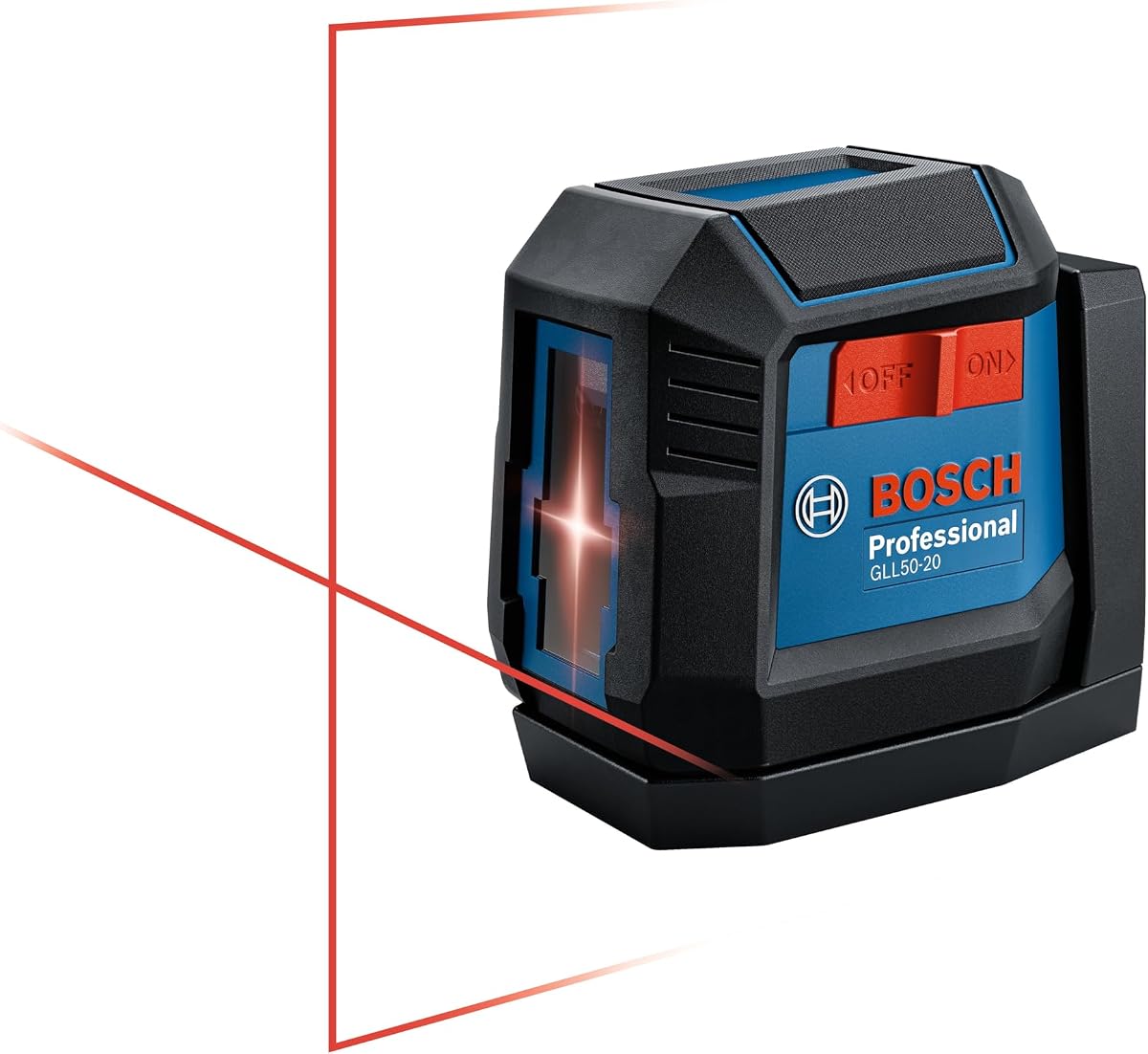
The Bosch GLL50-20 earns a place on finish vans because it is boring in the best way. Controls are few, the magnetic mount is part of the body, and IP55 sealing means drywall dust and damp garage floors are not an.
- Red cross-line, ~50 ft range
- Self-levels; out-of-level blinks
- IP55 dust and water resistance
- Integrated magnetic mount
- AA or optional Bosch Li-ion
- Bosch support network most crews already know
- IP55 sealing for dusty remodel cut-ins
- Magnetic mount sticks to track and door bucks
- AA power is easy to revive on site
- Thin lines that read well for trim reveals
- Red beam fights bright south-facing rooms
- 50 ft feels short in open great rooms
- No 360° planes for multi-wall cabinets
For finish carpentry layout, a red cross-line still excels when light is controlled—closets, interiors after windows are covered, evening punch lists. The thin beam is useful for marking equal casing reveals or checking whether a jamb is plumb before you commit shims. Self-leveling blinks when the pendulum is out.
This is not the best laser level for finish carpentry in sun-washed kitchens, where green usually wins on visibility. It also will not wrap a room the way a 360-degree tool does. What it does well is survive daily abuse and deliver a trustworthy.
Field habit: mount it solidly, wait for the line to settle, mark lightly, and leave the tool alone while you cut. After a hard drop or a hot truck week, check it against a known plumb jamb. Wipe the window; dust makes.
Door and jamb workflow with a red Bosch
Stick the magnetic mount to steel track or a temporary metal plate near the opening. Use the vertical line to read hinge-side plumb and the horizontal line to confirm head height consistency across a hallway of doors. If the beam blinks, the mount—not the wood—is the first thing to fix.
We earn a commission, at no additional cost to you.
3. DEWALT DW088K
Among red cross-line lasers that carpenters still buy new, the DEWALT DW088K remains the tough default. Its 4.7 rating reflects years of door bucks, stair landings, and remodel dust more than marketing adjectives. Overmolded housing, a stated drop rating, IP54 sealing, and a hard case are the difference between a.
- Self-leveling red cross-line
- Overmold housing; 1 m drop rating
- IP54 water and debris resistance
- Integrated magnetic bracket
- Hard case; 1/4-20 tripod thread
- Highest rating in this carpenter shortlist
- Built to live in a finish carpenter’s van
- Magnetic bracket that holds for door work
- Detector-ready for longer exterior pulls
- Familiar DEWALT service and parts path
- Red beam needs help in bright interiors
- Cross-line only — not full-room planes
- Tripod sold separately if you want height
Accuracy around an eighth of an inch at thirty feet is the class finish work expects when the mount is solid. The patented magnetic bracket is the feature you will use most: stick it to track, a temporary plate, or metal door hardware staging and establish plumb and level.
As the Best Jobsite Workhorse in this best laser level for carpenters guide, DW088K is ideal when your week mixes rough openings and finish. Pair it with a detector for brighter exterior work when the listing’s extended range matters; indoors, treat it as a reliable red.
Skip it only if your primary job is multi-wall cabinet installs that benefit from 360-degree planes. For doors, windows, built-in face frames, and trim crews who already trust DEWALT, it is still the tool that earns space when van real estate is scarce.
Why carpenters keep a red DEWALT around
Green lasers win visibility contests; red workhorses win attrition contests. Keep the DW088K for openings and punch lists, and add a green pocket or 360 tool when cabinet and trim packages dominate the schedule. Lock the pendulum for transport and store it in the hard case—finish dust is abrasive to optics.
We earn a commission, at no additional cost to you.
4. AikTryee Line Level Kit
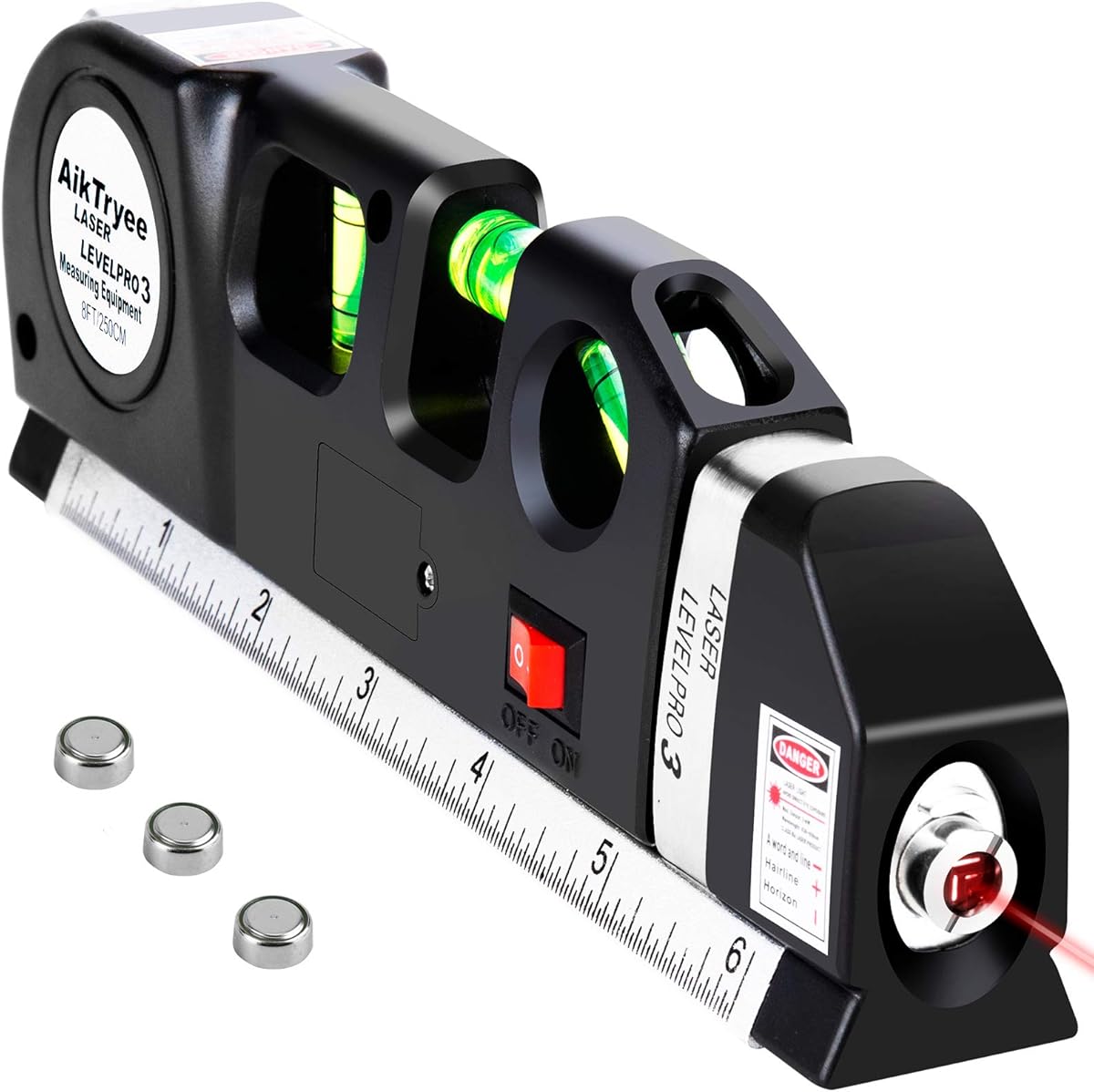
The AikTryee kit is not pretending to be a professional self-leveling plane tool, and that honesty is why it belongs in a carpenter roundup. It is a hybrid line guide with bubble vials and an eight-foot tape—the sort of thing that lives in a nail pouch for hanging cabinet hardware, centering a microwave.
- Cross, horizontal, and vertical beam modes
- 0°, 90°, and 45° bubble vials
- Integrated 8 ft tape measure
- Simple front slider controls
- Indoor hanging and cabinet helper
- Tape and vials in one hand for quick checks
- Useful for centering hardware and small cabinets
- 45° vial helps for common miter setups
- No charging cycle for occasional punch lists
- Inexpensive helper for apprentices on light tasks
- Not a true pendulum self-leveling jobsite laser
- Unsuitable as the primary finish layout system
- Hands-free stability cannot match a mounted laser
Finish carpenters can use it as a secondary check: establish level with the vials, project a visual guide with the beam, and measure spacing with the tape without switching tools. The 45-degree vial is handy when you are confirming a common miter setup on trim.
Where it fails is exactly where the best laser level for finish carpentry earns its keep. Long ledger lines, multi-door hallways, and continuous chair rails need a hands-free self-leveling reference. This tool asks you to hold or brace it carefully, and any slip becomes a crooked mark on finished paint.
Buy it as a convenience accessory for light interior tasks and training helpers on basic level concepts. Do not buy it as your main layout laser for paid cabinet or trim packages. Keep expectations aligned with the form factor and you will not be disappointed by what it cannot do.
A helper tool, not a layout system
Use the vials first, then the beam. For a short cabinet run, mark one end from a known reference and let the tape handle spacing. For anything that spans a room or sets finished elevations, switch to one of the self-leveling lasers ranked above or below this entry.
We earn a commission, at no additional cost to you.
5. Klein Tools 93CPLG
If this guide needs one clear Editor’s pick for finish carpentry, it is the Klein Tools 93CPLG. Three bright green 360-degree planes let you establish a continuous horizontal reference for upper cabinets, a vertical plane for the first box and appliance.
- Three 360° green laser planes
- Up to ~100 ft projection class
- 6+ hour rechargeable runtime
- Tilt/manual lock mode
- IP54 overmold; magnetic mount
- Wraparound planes speed cabinet and built-in layout
- Compact body fits pantries, closets, and mudrooms
- Green visibility on white cabinets and painted trim
- All-day rechargeable power for finish packages
- Klein brand carpenters and electricians already trust
- Costs more than generic cross-line kits
- No tripod in the base package
- Overkill if you only hang occasional doors
The compact magnetic body is what sells it on remodel sites. Pantries, wet bars, and closet built-ins rarely offer a generous staging area. Stick the mount to steel, set one plane at ledger height, and walk the room marking studs.
Tilt mode matters for stair-adjacent trim and intentional slopes, but leave the pendulum unlocked for level work. As the best laser level for finish carpentry in this set, the 93CPLG rewards crews who install cabinets, tall built-ins, and continuous moldings more than once a month. Pair it with.
Skip it if your work is mostly rough framing or single-door punch lists—the DEWALT or Bosch cross-lines are simpler. For cabinet-heavy finish packages, though, the Klein’s planes pay for themselves the first time you stop chasing a ledger line around a kitchen.
Cabinet install sequence with three planes
Turn on the horizontal plane first and mark the ledger. Add a vertical plane only when locating the first upper or checking an appliance reveal. Keep unused planes off so reflections on glossy doors do not confuse the eye. Recheck the ledger after anyone bumps the mount—cabinets amplify small drifts.
We earn a commission, at no additional cost to you.
6. CIGMAN 100ft Green Line

CIGMAN’s green line laser sits in the sweet spot for carpenters who want brighter indoor visibility without committing to a full 360 kit. A magnetic bracket and straightforward self-leveling make it useful for baseboard height, door casing checks, and short cabinet runs where one horizontal and one vertical reference are enough.
- Green self-leveling cross-line
- Magnetic bracket included
- Self-level, manual, and pulse modes
- Receiver-ready for brighter sites
- Indoor renovation and trim focus
- Green beam for bright kitchen and hall work
- Clear out-of-level flash behavior
- Magnetic bracket encourages solid mounts
- Pulse mode available with a separate receiver
- Strong value for finish crews adding a second laser
- Still a cross-line, not 360° coverage
- Tripod may be a separate purchase
- Brand support is less consistent than Bosch/DEWALT
The operating logic is worth learning because it matches how finish work actually fails. Unlock the pendulum for level lines; if the beam keeps flashing, the mount is outside the self-leveling window and the line is not trustworthy. Manual mode with a locked pendulum projects angles.
Compared with Motovera, you trade the included tripod for a cleaner focus on the laser and bracket. Compared with Klein’s 93CPLG, you give up wraparound planes. That makes this a smart second tool on a two-person finish crew: one carpenter runs cabinets.
Field-check accuracy after shipping before you set finished elevations. Keep the window clean, and do not mark through a flashing line. For the money-to-visibility balance among cross-line tools in this carpenter list, CIGMAN is hard to ignore.
Reading CIGMAN’s flash alerts on site
Continuous flashing in self-level mode means reseat the tool closer to level. A slow periodic flash in manual mode means the pendulum is locked on purpose. Confusing those two behaviors is how crooked chair rails get permanently installed.
We earn a commission, at no additional cost to you.
7. Digital Angle Cube Dual Laser

Carpentry is not only wall layout. Setting a table saw blade, matching a miter saw to an existing stair angle, or checking a machine table often matters as much as a ledger line. This magnetic digital angle cube with dual lasers fills that shop role: four-side.
- Magnetic digital angle finder cube
- Dual Class II laser lines
- ±0.2° class accuracy claim
- USB-C rechargeable battery
- IP67-rated aluminum body
- Sticks to saw blades, fences, and steel plates
- Dual lasers help transfer hanging and alignment marks
- Useful for table saw and miter angle setup
- Pocket size with belt bag for shop carry
- Relative zero mode for comparative angles
- Not a room-layout replacement for a pendulum laser
- Laser lines are short-range helpers, not 100 ft planes
- Learning the display modes takes a few sessions
As a companion to the best laser level for carpenters rather than a competitor, it shines when a pendulum laser cannot answer the question. Zero it on a known reference, transfer relative angles, and use the lasers for symmetrical hardware or short alignment marks. The rechargeable pack and.
Do not expect it to layout a kitchen. The lasers are Class II helpers, not whole-room green planes. Think of this tool as the bridge between digital angle work and light visual alignment—especially valuable for stair builders, furniture makers, and finish carpenters who cut a lot of compound trim.
Calibrate your trust with a known square and a verified angle before critical cuts. Magnets are strong; keep fingers clear when attaching near spinning equipment, and remove the cube before making the cut if it interferes with guards or fences.
Where the angle cube earns bench time
Use it to set blade tilt, check a miter saw against an existing wall angle, or confirm a fence is square to the table. For wall layout of cabinets and trim, return to a self-leveling cross-line or 360 laser. The two tools solve different problems on the same job.
We earn a commission, at no additional cost to you.
8. Fanttik D2 Pocket
Finish carpenters spend as much time on punch lists as on first installs. The Fanttik D2 is the pocket green laser you actually carry up a finished staircase without clearing a path for a hard case. At roughly half a pound with a rotating.
- Pocket green cross line ~100 ft
- 2200 mAh; long rechargeable runtime
- Rotating magnetic bracket
- Self-level, manual, and pulse modes
- USB-C charging; carry pouch
- Truly pocketable for punch-list trim days
- Bright green lines on painted casing and cabinets
- Rotating magnetic bracket for awkward mounts
- Long runtime without hauling AA sleeves
- Pulse mode available with a receiver
- Cross-line only — not whole-room planes
- Plastic body vs heavy overmold pro tools
- No tripod included in the pocket kit
Self-leveling handles normal wall work; manual mode covers stair accents; pulse mode is there if you ever need a receiver outdoors. USB-C charging and a long runtime claim mean the tool is ready after a night on the charger instead of a scavenger hunt for AAs. For many carpenters.
It will not replace the Klein 360 for a full kitchen of cabinets, and it is not as drop-hardened as the DEWALT DW088K. Use it as the everyday green reference that lives in a pouch beside a block plane and a nail set. Mount it, wait for the line to settle, mark lightly.
If your work is mostly large multi-wall installs, buy the Klein first and add the D2 later. If your work is doors, trim, and service calls, the D2 may be the only laser you need most weeks.
Punch-list habits that keep the D2 honest
On finished floors, use the magnetic bracket on a temporary steel plate or track rather than balancing the tool on trim. Recheck after anyone walks past with a ladder. Lock the pendulum for transport so the pocket tool does not take a pendulum hit inside a pouch full of fasteners.
We earn a commission, at no additional cost to you.
9. Bosch GLL50-20G

The GLL50-20G is the version of Bosch’s compact cross-line that finish carpenters should shortlist when kitchens and hallways stay bright. You keep the integrated magnetic mount, IP55 sealing, and simple self-leveling behavior of the red model, but the green beam is easier to see against white cabinets, primed casing, and freshly painted walls.
- Green-beam cross line ~50 ft
- Self-leveling pendulum system
- IP55 dust and water resistance
- Integrated magnetic mount
- AA batteries and soft pouch
- Green visibility upgrade over the red GLL50-20
- Same Bosch magnetic mount and IP55 sealing
- Thin lines suited to casing and reveal work
- AA power with optional Bosch Li-ion path
- Pouch-friendly size for finish bags
- Still cross-line only, not 360 planes
- 50 ft may feel short in large open plans
- Green models usually cost more than red siblings
For the best laser level for carpentry tasks that stay in the cross-line category—doors, windows, chair rail, and short cabinet runs—this Bosch strikes a trusted-brand balance. Accuracy in the same class as its red sibling is adequate when the mount is solid.
Choose it over Fanttik when brand support and sealing matter more than pocket weight. Choose it over Klein when you do not need 360 planes and want a simpler two-line tool. Choose the red GLL50-20 instead only if you work mostly in controlled light and want to save on the green premium.
As always with Bosch pendulums, lock for transport, wait for a solid line before marking, and verify after shipping. Green does not forgive a tipped mount; it only makes the mistake easier to see.
Green Bosch vs pocket Fanttik on trim days
Pick Bosch when you want IP55 sealing and a brand you can take to a service center. Pick Fanttik when pouch weight and rotating bracket convenience matter more. Both are cross-line tools; neither replaces a 360 laser for a full cabinet package.
We earn a commission, at no additional cost to you.
10. eSynic Magnetic Angle Gauge

The eSynic magnetic angle gauge is the carpenter-specific answer when your question is degrees, not a wall ledger. Four-side magnets grab saw blades, machine tables, and steel beams; the backlit display stays readable in a dim shop or a sunlit entry; and dual lasers give a.
- 4-side neodymium magnetic body
- Dual Class II laser lines
- Backlit reverse-display LCD
- USB-C recharge; 7+ hour claim
- IP54 sealing; hold and zero modes
- Highest rating among the angle tools here
- Strong magnets for blades, tables, and steel
- Readable display in dim shops and bright doors
- Dual lasers help short alignment transfers
- Zero and hold modes speed comparative measuring
- Cannot replace a room-layout pendulum laser
- Display errors if tilted beyond its usable window
- Lasers are helpers, not long indoor cross-lines
Finish carpenters use tools like this to match an existing stair angle, set a miter saw to a wall that is not square, or confirm a table saw bevel before cutting expensive stock. Relative zero mode lets you compare against a reference instead of trusting absolute numbers alone. Hold freezes a reading when.
Pair it with a self-leveling wall laser rather than treating it as the only layout device on site. The lasers will not wrap a kitchen; the IP54 body will survive ordinary shop dust and splashes but is not an excuse for abuse. Recharge over USB-C between.
If you already own a trusted digital angle finder without lasers, you may not need a second cube. If you want one shop tool that combines magnets, a clear display, and short laser guides for carpentry, eSynic is the stronger of the two angle options in this roundup.
Stair and miter workflow with an angle gauge
Capture the existing angle on the wall or stringer, zero or hold as needed, then transfer that number to the saw. Use the lasers only for short visual confirmation. For plumb and level of the finished trim, verify again with a self-leveling cross-line or 360 laser after the parts are cut.
We earn a commission, at no additional cost to you.
Buying Guide — How to Choose the Best Laser Level for Carpenters
The best laser level for carpenters matches the work on your schedule: doors and trim, multi-wall cabinets, stair angles, or a mix. Use the factors below to avoid buying an outdoor rotary you will not use, or a novelty hanger that cannot hold a ledger line across a kitchen.
Match the tool to finish vs shop questions
Wall layout wants a self-leveling cross-line or 360-degree laser. Shop and stair angle work wants a magnetic digital angle finder. Many finish carpenters eventually own both: a green layout laser for elevations and a cube for blades and miters. Buying only the angle cube leaves you guessing on cabinet ledgers; buying only a cross-line leaves you guessing on compound cuts.
Cross-line vs 360 planes for carpentry
A cross-line laser is enough for doors, windows, casing reveals, and short trim runs. Choose three 360-degree planes when you install cabinets, tall built-ins, or continuous moldings around corners and hate resetting the tool. The Klein 93CPLG is the clearest finish-layout upgrade in this guide for that reason.
Green visibility on painted finish work
White cabinets, primed casing, and bright kitchens favor green beams. Red still works in controlled light and on durable platforms like DEWALT and Bosch, and many carpenters keep a red workhorse for openings. Outdoors or in harsh daylight, plan on pulse mode plus a receiver regardless of color—visible beams wash out.
Mounts that survive real finish sites
Crooked installs usually start with a bumped mount. Magnetic brackets on steel track or temporary plates beat tape on dusty drywall. Tripods help for long ledger sessions at standing height. Tighten the mount, wait for self-leveling to finish, then leave the tool alone while you mark and cut.
How to Use a Laser Level for Finish Carpentry
Clear a stable mount—tripod, magnetic bracket on steel, or a solid temporary plate. Unlock the pendulum for self-leveling and wait until the line stops hunting. If it blinks continuously, reseat the tool closer to level before you mark paint, cabinet sides, or door jambs.
For cabinets, set one horizontal plane or line at ledger height and mark every stud lightly. Add a vertical reference only when locating the first box or checking an appliance reveal. For doors, use the vertical line to read hinge-side plumb and the horizontal line to keep head heights consistent down a hallway.
Frequently Asked Questions
What is the best laser level for carpenters in 2026?
For finish carpentry layout, the Klein Tools 93CPLG is our top pick because three green 360-degree planes speed cabinets and built-ins. For a tough daily cross-line, choose the DEWALT DW088K. For pocket trim and punch lists, choose the Fanttik D2.
What is the best laser level for finish carpentry?
Finish carpentry favors a bright self-leveling green laser you can mount solidly at ledger or trim height. A compact 360-degree tool like the Klein 93CPLG is ideal for multi-wall cabinets; a green cross-line like the Fanttik D2 or Bosch GLL50-20G is enough for doors and trim.
Do carpenters need a 360-degree laser level?
Not always. Door and trim specialists can work happily with a quality cross-line. Cabinet installers and built-in crews usually save time with 360-degree planes that keep a continuous reference around corners.
Is a green laser better than red for carpentry?
Indoors on bright finish sites, green is usually easier to see on white cabinets and painted trim. Red workhorses like the DEWALT DW088K still excel for durability and openings. In direct sun, use pulse mode and a receiver either way.
Can a digital angle finder replace a laser level?
No. An angle cube answers blade and miter questions; a self-leveling laser answers wall elevations and plumb. Most carpenters who cut stairs and hang cabinets eventually want both.
Final Thoughts on the Best Laser Level for Carpenters
For most finish carpenters, start with the Top 3: Klein Tools 93CPLG for multi-wall cabinet and built-in layout, DEWALT DW088K as the durable jobsite cross-line, and Fanttik D2 as the pocket green trim tool you will actually carry on punch lists.
Match the tool to the work—cross-line for doors and casing, 360 planes for cabinets, and a magnetic digital angle gauge for saw and stair angles. Related searches such as best laser level for finish carpentry and best laser level for carpentry should lead you to the kit you will mount carefully every time, not the longest marketing range on the page.