
A wall does not forgive a crooked line the way a floor sometimes does. Once paint, tile, or a row of hooks is up, every eighth-inch drift shows. The best wall laser level is the tool that puts a trustworthy horizontal or vertical reference on the surface you are actually working—whether that means clipping a laser to drywall, sticking a magnetic base to steel track, hanging a wall attachment at picture height, or parking a compact green cross-line on a short tripod a few feet back from the plaster.
This roundup stays on wall layout: shelves, cabinets, accent strips, wainscoting, tile starts, gallery walls, curtain rods, and the kind of indoor remodel work where the plane that matters is vertical. We skipped outdoor rotary kits and long-range grading tools on purpose. Below you will find Top 3 picks, a side-by-side comparison, ten editorial reviews, and a buying guide written for people who spend more time facing a stud bay than a foundation form.
Top 3 Picks for Best Wall Laser Level
CIGMAN 3×360° Green Laser Level

- Full 360° green planes that wrap adjoining walls
- Remote and magnetic rotating stand for wall-side work
- Strong 4.6 rating for remodel and finish layout
ZANIS Multi-Surface Laser Level

- Pins, screw slot, and reusable sticky pads
- Dual dials for precise wall-adjacent aiming
- Purpose-built for hanging and shelf layout
Fanttik D2 Pocket Green Laser

- Pocket green cross line with magnetic 360° bracket
- USB-C rechargeable for quick wall sessions
- Excellent pick for shelves, frames, and mounts
Affiliate Disclosure: As an Amazon Associate we earn from qualifying purchases. We earn a commission, at no additional cost to you.
Top 10 Best Wall Laser Levels in 2026 Compared
Compare mounting style, beam type, and kit extras for wall layout before reading the full reviews. Shortlist a wall-mountable laser, a magnetic cross-line, or a room-wrapping 3×360° tool, then confirm accessories on the live listing. No prices are listed because Amazon bundles change.
- 3×360° green planes (12 lines)
- Rechargeable battery + remote
- Magnetic rotating stand for walls
- ~30 ft indoor laser line
- Pins, pads, and screw-slot mount
- Dual dials + bubble level
- Pocket green cross line ~100 ft
- Magnetic 360° rotating bracket
- USB-C rechargeable battery
- Green cross line, ~100 ft indoor
- Self-level + manual + pulse
- Aluminum tripod included
- Red cross-line laser, ~50 ft
- IP55 dust/water sealing
- Integrated magnetic mount
- Self-leveling with backlit vials
- 360° rotating wall attachment
- AA batteries included
- Green cross beams; self-level/manual
- 50-inch tripod with pouch
- AA batteries included
- H/V/cross laser line modes
- Bubble vials + 8 ft tape
- Compact wall décor layout aid
- Green cross line ~100 ft indoor
- 3 brightness modes + pulse
- Compact 25.6-inch tripod kit
- Green cross line; ~100 ft claim
- Aluminum alloy tripod included
- IP54 body; pouch + battery
We earn a commission, at no additional cost to you.
Detailed Product Reviews
1. CIGMAN 3×360° Green Laser Level
If your walls talk to each other—an L-shaped living room, a kitchen with returns, a hallway that needs the same chair-rail height on both sides—a basic cross-line laser forces you to leapfrog the tool and hope your pencil marks survive. The CIGMAN 3×360° is our Editor’s Choice for the best wall laser level because it projects continuous green planes that stay with you as you turn a corner. Its 4.6 rating reflects that balance of brightness, kit completeness, and everyday remodel usefulness.
- 3×360° green planes (12 lines)
- Rechargeable 4000 mAh pack
- Remote + magnetic rotating stand
- Self-level, manual, and pulse modes
- IP54 compact housing
- Wraps a continuous height around corners
- Remote lets you adjust lines from the wall
- Magnetic stand sticks to steel track and plates
- Strong rating for remodel-level feature set
- Type-C charging suits multi-day wall projects
- More tool than a single picture row needs
- Outdoor daylight still wants a receiver
- Brand support varies by region
For wall layout specifically, leave the floor plane alone and work the horizontal ring at the height you care about: tile start, floating shelf datum, wainscot top, or cabinet scribe. The vertical plane becomes your plumb reference when a TV mount, closet system, or stacked gallery needs a true centerline. The magnetic rotating stand is the quiet hero on jobsite steel and temporary plates; the remote matters when you are standing against the wall with a tape and do not want to walk back to the laser every time a plane needs toggling.
This is still an indoor-first tool. Pulse mode can extend usefulness with a receiver, but the reason to buy CIGMAN here is wall-to-wall consistency, not driveway grading. Compared with pocket cross-line lasers, it is bulkier and less drawer-friendly. Compared with true wall-pin gadgets, it sits farther from the plaster and asks for a stable mount. If your calendar includes cabinets, multi-wall tile, and finish carpentry—not only weekend frames—this is the laser that earns its shelf space.
One practical habit separates clean wall layout from messy second-guessing: establish the horizontal datum once, transfer it around the room, and only then open the vertical plane for centers and plumb stacks. The rechargeable pack is sized for remodel days rather than a single picture hook, so charge it the night before a cabinet or tile weekend. If you mostly hang art in one rectangular room and never turn a corner with the same height, a simpler cross-line kit will feel less ceremonial—and that is fine.
Wall workflow tip — CIGMAN 3×360°
Set one solid horizontal datum early, mark lightly with a pencil at stud locations, then shut off unused planes so the wall is not a light show. Confirm the live listing still includes the remote and magnetic stand before you order. When you move the magnetic stand, recheck the line against your first mark before drilling the next wall.
We earn a commission, at no additional cost to you.
2. ZANIS Multi-Surface Laser Level
Most laser levels assume you will stand the tool somewhere clever and shoot a line onto the wall. ZANIS flips that assumption. It is built to live on the wall—pins into suitable drywall, a screw slot over an existing fastener, or reusable sticky pads on tile, glass, and smooth metal. For renters, decorators, and anyone who hates stacking books under a tripod, that design difference is the whole product.
- ~30 ft indoor laser line
- MountBase with pins for drywall
- Screw slot for existing anchors
- 14 reusable sticky pads included
- Dual dials with bubble level
- Attaches at the wall where the work is
- Multiple mount methods for mixed surfaces
- Fine mechanical aiming with dual dials
- Full kit includes pads, pins, and screwdriver
- Ideal for shelves, mirrors, and gallery rows
- Lower rating than self-leveling green kits
- Shorter indoor reach than 100 ft lasers
- Not a set-and-forget pendulum laser
The dual-dial system and bubble level reward slow, deliberate placement. You mount the body near the future shelf or frame row, dial the line until the bubble agrees, then mark. The roughly 30-foot indoor reach is enough for a typical residential wall; it is not enough for a bright open loft where you hoped to park the laser in the opposite corner. Treat it as a wall-adjacent layout instrument, not a room-filling green plane machine.
The 3.9 rating is honest feedback you should read before buying. Sticky pads need clean surfaces and patience; pins leave tiny holes you may need to patch; mechanical dials ask for more user care than a self-leveling pendulum. When those tradeoffs fit your projects, ZANIS is still the most purpose-built wall-mounted laser in this guide—and the clearest answer when someone specifically asks for a laser level that mounts to the wall.
Think of ZANIS as a wall layout jig more than a construction laser. It shines when you are alone on a ladder-height mirror, fine-tuning a shelf an inch at a time, or working a finished room where dragging a tripod across hardwood feels wrong. It is a weaker match for dusty gut-renovations, outdoor pulse work, or anyone who wants a pendulum to self-level while they walk away. Read recent reviews for pad longevity, then match the mount method to your actual wall finish.
Wall workflow tip — ZANIS Multi-Surface
Test pad adhesion on an inconspicuous patch of the same finish before committing to a finished face. Keep a hand near the tool while you dial; never trust a fresh pad alone over tile that still has polish residue. On drywall, prefer pins or a screw slot when the finish is fragile or freshly painted.
We earn a commission, at no additional cost to you.
3. Fanttik D2 Pocket Green Laser
Wall work is often interrupt-driven: hang three frames after dinner, set one shelf before guests arrive, check a TV mount while the kids nap. The Fanttik D2 fits that rhythm. It is light, green, self-leveling, and small enough that you will actually retrieve it instead of improvising with a spirit level and crossed fingers. The 4.6 rating is one of the stronger signals in this wall-focused list.
- Pocket green cross line ~100 ft
- 2200 mAh, ~10 hour runtime claim
- Magnetic 360° rotating bracket
- Self-level + manual + pulse
- USB-C charging + carry pouch
- Truly pocketable for quick wall sessions
- Bright green cross for bright kitchens
- Rotating magnetic bracket aims cleanly
- High 4.6 rating in a small package
- Rechargeable battery skips AA hunts
- Cross-line only — no full 360 planes
- Needs metal or a small tripod nearby
- Not a hard-shell jobsite tank
The magnetic bracket’s free rotation is more useful for wall layout than many people expect. Clip it to a steel door frame, temporary plate, or metal track, then sweep the horizontal line across the plaster without lifting the body. That motion helps when furniture, lampshades, or trim interrupt a fixed aim. The claimed indoor reach is generous for residential walls; brightness and a solid mount matter more than the marketing number.
Buy the D2 when your walls are mostly décor and light remodel, not whole-house tile. It will not wrap a continuous plane around a room the way CIGMAN does, and it will not pin directly into drywall the way ZANIS does. What it will do is give you a crisp green cross, long enough runtime for several projects, and a pouch that disappears into a drawer. For many homeowners, that is the practical definition of the best laser level for walls.
Pulse mode and outdoor receiver talk on the listing should not distract you. This guide is about indoor wall layout, and the D2 earns its badge because it is bright, portable, and quick to aim on a magnetic bracket. Charge it with USB-C the same way you charge everything else in the house, wipe the window after dusty shelf installs, and lock or power down according to the manual before it rides in a toolbox.
Wall workflow tip — Fanttik D2
If the wall has no steel nearby, keep a tiny 1/4u0022-20 tabletop tripod in the same pouch. A bumped magnet is the usual cause of a crooked shelf, not the diode. After rotating the bracket, wait a beat for self-leveling to settle before you mark.
We earn a commission, at no additional cost to you.
4. Motovera 100ft Green Cross-Line Kit

A wall laser is only as useful as its height. Motovera’s kit understands that: the included aluminum tripod gets a green horizontal line off the floor and into the zone where shelves, pictures, and tile starts actually live. For a first purchase aimed at wall layout, that “open the box and work” feeling matters more than collecting accessory SKUs later.
- Green cross line, ~100 ft indoor
- Self-level + manual + pulse
- Four brightness modes
- Aluminum tripod included
- IP54 dust/water resistant
- Tripod puts the beam at wall height immediately
- Green cross visible in typical indoor light
- Brightness modes help day-to-night rooms
- Manual mode for intentional wall angles
- Complete starter kit without extra shopping
- Cross-line only — not full wall-wrapping planes
- Tripod is light-duty versus pro stands
- Accuracy is DIY-class, not survey-grade
Self-leveling mode is the daily driver. Unlock the pendulum, wait for the line to settle, and treat continuous flashing as a “reseat me” warning rather than a mystery fault. Four brightness settings are surprisingly relevant on walls that face windows; a line that looks perfect at dusk can wash out at noon. Manual mode is for stair displays and deliberate diagonals—not for claiming a shelf is level while the pendulum is locked.
Choose Motovera when you want a green cross-line wall reference without paying for 3×360° coverage you may never use. Leave outdoor pulse dreams for another tool. After shipping, run a simple wall check: mark the line, rotate the tool 180 degrees on the same spot, and compare. If those marks agree closely enough for paint and hooks, you are ready to hang.
The kit also teaches good wall habits: set height once, mark the whole run, then hang. Brightness modes let you dim the beam in a dark hallway or punch it up when afternoon sun hits a white wall. If you already own a sturdy camera tripod with a 1/4-inch thread, you could buy a bare laser elsewhere—but as a first wall-layout purchase, the included stand removes the excuse that stalls most weekend projects.
Wall workflow tip — Motovera kit
Extend the tripod deliberately and keep traffic clear while marking. Most Motovera wall mistakes come from a bumped light stand, not from the laser’s stated accuracy. Use the vertical beam to center a stack before you commit to the horizontal hook line.
We earn a commission, at no additional cost to you.
5. Bosch GLL50-20
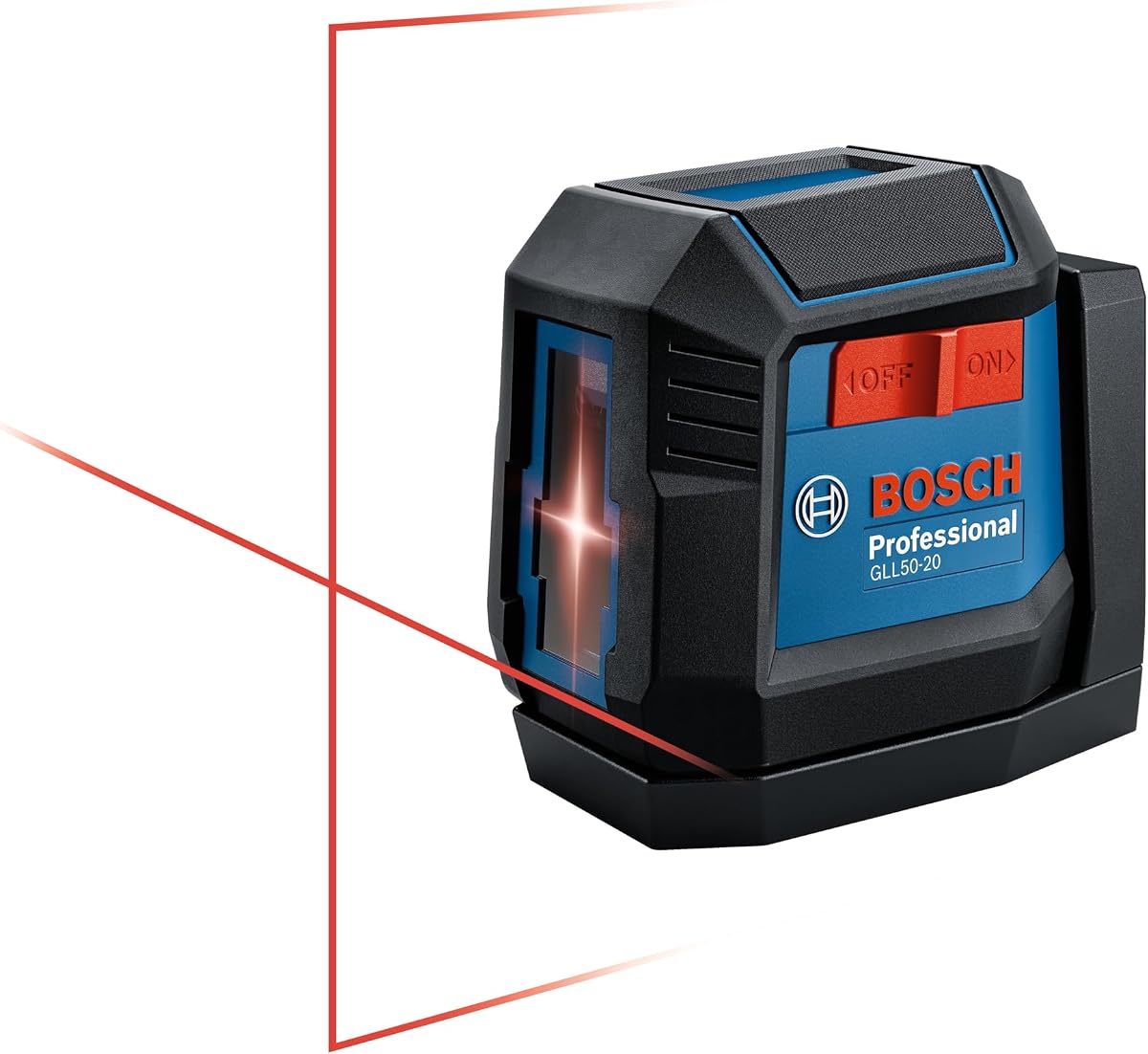
Open a wall and the jobsite changes: dust, temporary steel, half-finished electrical, and light that is rarely flattering. The Bosch GLL50-20 is the wall laser for that environment. It is not the brightest showpiece in this guide, but its integrated magnetic mount, IP55 sealing, and simple self-leveling behavior make it a trustworthy companion when you are laying out boxes, blocking, and finish lines on real remodel walls.
- Red cross-line, ~50 ft range
- Self-levels; out-of-level blinks
- IP55 dust and water sealing
- Integrated magnetic mount
- AA or optional Bosch Li-ion
- Bosch support and predictable controls
- Magnetic mount loves steel track and plates
- IP55 survives dusty wall tear-outs
- AA power is easy to find mid-project
- Compact body stores with remodel tools
- Red beam loses to green in bright rooms
- 50 ft is shorter than many green kits
- No 360° wall-wrapping planes
Red is the compromise. In a dim hallway or a room with controlled lighting, the thin cross line is crisp enough for accurate marks. In a white, sunlit living room, a green Fanttik or Motovera will be easier on the eyes. Bosch’s roughly 50-foot range is still more wall than most residential projects need; what you want is a stable magnet and a line that does not wander while you drill.
Pros who already own Bosch batteries may appreciate the optional lithium path; everyone else can live on AA cells without drama. Skip this model if your only job is a bright gallery wall and you refuse to dim the room. Choose it if the same tool must survive drywall dust on Monday and hang curtain rods on Saturday.
On wall layout days, the Bosch shines when you can park it on metal and leave it alone. Mark outlet heights, align blocking, or run a horizontal reference for chair rail without hunting for a tripod footprint in a crowded room. It will not replace a green 3×360° system for wrapping cabinets around a kitchen, but as a durable laser level for walls under construction, it is hard to argue with.
Wall workflow tip — Bosch GLL50-20
Stick the magnet to steel track or a temporary plate at roughly the height of the work. Mark lightly, then step back—do not chase the beam by nudging the housing after it has settled. In bright rooms, work earlier or later in the day when the red line holds contrast.
We earn a commission, at no additional cost to you.
6. BLACK+DECKER BDL220S

Before rechargeable pocket lasers and 3×360° kits dominated listing photos, tools like the BLACK+DECKER BDL220S answered a plain question: can I put a level reference on the wall and rotate it where I need it? That mission still holds up. The 360-degree wall attachment is genuinely useful for curtain rods, mirror centers, shelf brackets, and any project where standing a tripod in the middle of the room feels theatrical.
- Self-leveling laser line
- 360° rotating wall attachment
- Two backlit bubble vials
- AA batteries included
- Compact household footprint
- Wall attachment puts the laser at the work
- Rotation helps curtain rods and shelf runs
- Backlit vials help in dim rooms
- Familiar household brand support
- Simple AA ownership routine
- Not a modern long-range green diode
- Modest beam against bright window glare
- Class 3R — use normal laser eye caution
Expect a household-scale beam, not a jobsite floodlight. Backlit vials help you confirm the story the laser is telling, especially in a closet or evening living room. Self-leveling assists setup, but you should still read the model instructions and treat the vials as a second opinion before you commit to holes. This is a décor and light-install tool, not a substitute for a green plane laser on a multi-wall tile job.
Buyers who want the newest green diode specifications will look elsewhere. Buyers who want a wall-first workflow from a known brand often land here and stay. Keep the beam away from eyes and reflective surfaces, work indoors, and you will understand why this older design still appears in wall-laser conversations.
Use it as a dedicated décor laser rather than your only remodel tool. Curtain rods across a wide window, a mirror centered over a vanity, or a clean row of coat hooks are its natural habitat. Pair it with a stud finder and a tape for spacing, and you cover most apartment wall tasks without learning a remote-controlled plane system.
Wall workflow tip — BLACK+DECKER BDL220S
Mount the attachment securely before you rotate for angles. A loose wall mount creates more crooked rods than a weak laser ever will. Recheck the backlit vials after every major rotation.
We earn a commission, at no additional cost to you.
7. Lusweimi Green Laser with 50u0022 Tripod

Wall height is awkward with short pocket tripods. Lusweimi’s 50-inch stand solves the most common living-room problem: getting a green horizontal line to the middle of a gallery wall or the underside of a shelf run without improvising furniture stacks. Pair that with a self-leveling green cross and you have a calm, two-handed workflow—one hand marking, one hand holding the frame against the line.
- Green horizontal and vertical cross
- Self-leveling within ~±4°
- Manual lock for angled lines
- 50-inch tripod with bubble
- AA batteries and carry pouch
- 50-inch height reaches typical wall datums
- Green beams read well indoors
- Tripod bubble helps stable setups
- Pouch keeps the kit grab-and-go
- Good middle path between pocket and 360 planes
- Brand is less established than Bosch
- Still cross-line, not whole-room planes
- Verify accuracy after shipping
Unlock for self-leveling and respect the flash warning when the body sits outside the tilt window. The vertical beam earns its keep on stacked frames, closet systems, and wall-mounted TVs that need a true center. Manual mode is available for intentional slopes; remember that a locked pendulum is no longer a level reference even if the line looks pretty.
Because the brand is less familiar than Bosch or BLACK+DECKER, do a 180-degree wall check on arrival. If the marks agree, you have a practical wall kit that prioritizes height and visibility over feature bloat. It is an especially friendly pick for homeowners who know they will hang art and shelves but are not ready for a remote-controlled 3×360° system.
Compared with Motovera, the taller stand is the differentiator for sofa-height gallery walls and higher shelf runs. Compared with Fanttik, you trade pocket portability for less dependence on nearby steel. Keep the pouch stocked with spare AA cells so a half-finished wall never waits on a shopping trip.
Wall workflow tip — Lusweimi 50u0022 kit
Set the tripod once at final line height, lock the legs, then mark the entire wall before moving anything. Repositioning mid-row is how equal gaps become unequal. If the floor slopes, level the tripod head first, then trust the laser’s self-leveling window.
We earn a commission, at no additional cost to you.
8. AikTryee Multipurpose Laser Level
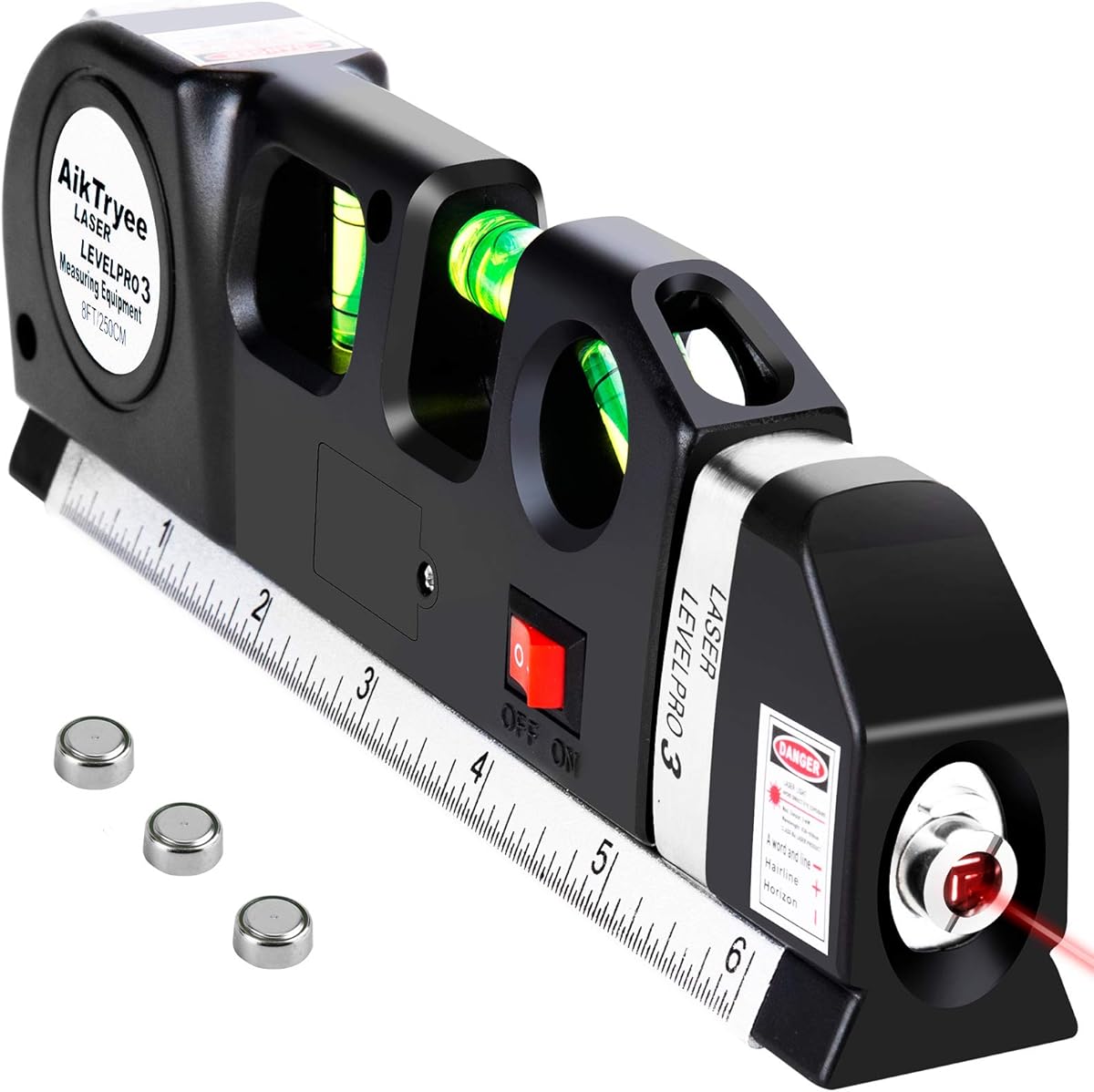
Some wall jobs are less about wrapping a room in laser planes and more about answering three questions at once: Is this line level? Is this gap even? How far is the next hook? AikTryee’s multipurpose kit is built around that triad. Laser line modes, bubble vials, and an eight-foot tape live in one compact body you can keep in a kitchen drawer.
- Horizontal, vertical, and cross modes
- 0°, 90°, and 45° bubble vials
- 8 ft / 2.5 m measuring tape
- Metric and imperial graduations
- Compact drawer-sized body
- Tape plus laser helps spacing on walls
- Bubble vials teach a careful setup habit
- Mode switch covers basic line needs
- Inexpensive entry for light décor work
- Easy for first-time wall projects
- Not a hands-off self-leveling pendulum tool
- Beam and build are basic versus green kits
- Less ideal for bright open-plan walls
Success depends on user care. Square the body with the vials before you trust the beam, then use the tape for equal spacing between frames or the offset from a doorway. It rewards a patient homeowner more than a production carpenter. Compared with Fanttik or Motovera, you give up automatic self-leveling convenience and green-beam punch; you gain a measuring habit that many laser-only users still do poorly by eye.
Pick AikTryee for small apartment walls, a first gallery, or a single shelf where overbuying a 3×360° kit would be silly. Move up when you start tiling full walls, hanging cabinets, or fighting bright window glare every weekend.
The 45-degree vial is a niche but real help for chevron accents and certain trim layouts. Still, most owners will live in horizontal and cross modes. Treat the kit as a teaching tool that forces you to confirm level with your eyes and vials—skills that transfer when you eventually upgrade to a self-leveling green cross-line.
Wall workflow tip — AikTryee kit
Establish the level line first, then measure spacing with the tape—never the reverse. A perfectly spaced row that drifts downhill is still a crooked wall. Hold the body firmly against the wall or a straightedge so the vials can do their job.
We earn a commission, at no additional cost to you.
9. Motover LL-T2 Green + Tripod

Not every wall project happens in a generous living room. Closets, powder rooms, and narrow hallways punish tall stands and bulky 3×360° bodies. The Motover LL-T2 kit pairs a green cross-line laser with a compact tripod that folds small and extends only as high as many tight spaces allow. That makes it a situational wall tool: excellent when footprint matters, less ideal when you need a beam at eight feet over a sofa.
- Green cross line ~100 ft indoor
- Self-level + manual + pulse
- Three brightness modes
- Compact tripod ~9–25.6 in
- IP54 housing; Class II laser
- Small tripod fits closets and hallways
- Green beam with brightness control
- Pulse mode available when needed
- Quick-release plate speeds setup
- IP54 body for dusty indoor walls
- Lower rating than several peers here
- Short tripod may not reach high wall datums
- Initial calibration check recommended
Brightness modes help tune the line for the room, and self-leveling covers ordinary plumb and level marks. The listing notes an initial calibration check before first use—do that on a known reference wall before you trust a critical tile start. Pulse mode is present for brighter sites with a receiver; for this article’s wall focus, treat it as a bonus rather than the reason to buy.
The 4.1 rating is a reminder to read recent feedback and verify the current bundle. If your walls are mostly mid-height and your storage is limited, the compact stand is a genuine advantage. If you routinely layout tall gallery walls or ceiling-adjacent trim, prefer the Lusweimi 50-inch kit or a wall-mounted design like ZANIS or BLACK+DECKER.
In practice, this kit is a hallway and closet specialist that also handles modest bedroom walls. The quick-release plate helps when you bounce between two walls in a small remodel. Just remember that a short tripod cannot invent height: if your datum sits near eight feet, choose a taller stand or a true wall mount instead of forcing this one.
Wall workflow tip — Motover LL-T2
Respect the tripod’s load limit and keep the head locked after aiming. In tight rooms, a soft bump from a door swing is enough to ruin a carefully marked row. Run the maker’s suggested first-use calibration on a quiet reference wall before tile or cabinetry marks.
We earn a commission, at no additional cost to you.
10. Nikotek Green Cross-Line Kit

Nikotek’s appeal is restraint. You get a green horizontal and vertical cross, a self-leveling pendulum with a clear out-of-level flash, an aluminum tripod, and a pouch—then you get out of the way and mark the wall. For homeowners who find remote-controlled plane lasers intimidating, that simplicity is a feature. The roughly 100-foot indoor claim is more marketing headroom than a typical bedroom wall needs.
- Bright green cross line ~110°
- Self-levels within ~3.5°
- Aluminum alloy tripod included
- IP54 dust/water resistance
- 1/4u0022 thread; pouch + battery
- Simple slide-to-start wall workflow
- Green cross for indoor décor layout
- Aluminum tripod feels sturdier than toy stands
- Palm-sized laser body stores easily
- IP54 sealing for light remodel dust
- Cross-line only — not multi-wall planes
- Less feature depth than CIGMAN or Fanttik
- Confirm current battery/pouch contents
Self-leveling within about 3.5 degrees covers normal floor unevenness. If the line flashes continuously, nudge the tripod closer to level instead of marking through the warning. The 1/4-inch thread also means you can graduate to a taller stand later without replacing the laser body. IP54 sealing is appropriate for dusty indoor remodel days, not for pressure washing or exterior grading.
Choose Nikotek when you want a green wall reference with a real metal tripod and few decisions. Choose CIGMAN when adjoining walls must share one continuous height. Choose ZANIS or BLACK+DECKER when the laser itself should hang on the wall. As a tenth option in a wall-focused roundup, Nikotek is the clean “just hang the shelf” kit.
It also pairs well with first-time remodelers who want green visibility without learning plane combinations and remotes. Keep expectations honest: this is a cross-line wall helper, not a layout system for an entire kitchen. Used that way, the aluminum tripod and simple controls make it a reliable closer for décor-driven wall projects.
Wall workflow tip — Nikotek kit
After the beam settles, mark stud locations with light pencil ticks above the eventual fastener height so the finished hardware covers your layout marks. If the line flashes, fix the tripod attitude before you drill a single hole.
We earn a commission, at no additional cost to you.
Buying Guide — How to Choose the Best Wall Laser Level
The best laser level for walls matches how you attach the tool, how bright the room is, and whether you need one wall or a continuous height around a corner. Use these factors to avoid buying an outdoor rotary kit for a gallery wall—or a tiny gadget for a whole kitchen of cabinets. Mounting method usually matters more than chasing the longest advertised indoor range.
Mounting: wall attachment vs magnet vs tripod
Wall layout fails most often at the mount, not the diode. True wall-mounted tools (ZANIS pins/pads, BLACK+DECKER’s rotating attachment) put the reference at the work. Magnetic mounts (Bosch, Fanttik, CIGMAN’s stand) shine on steel track and temporary plates. Tripods (Motovera, Lusweimi, Nikotek, Motover) win in open rooms when you need a free-standing height.
Pick the mount you can keep stable for the whole marking session. A bright green line on a wobbly stand is still a crooked shelf. If you work alone, favor any setup that lets both hands mark and hold hardware without babysitting the laser body.
Cross-line vs 3×360° for wall projects
A cross-line laser is enough for one wall of shelves, pictures, or a tile start. A 3×360° tool like the CIGMAN earns its keep when the same height must turn a corner, meet cabinetry on an adjacent wall, or stay consistent around a room. More planes are not automatically better for a single gallery row—they can distract.
Buy cross-line for focused wall décor. Buy 3×360° when multi-wall finish work is a regular habit. If you are unsure, start with a strong cross-line kit and upgrade only after you notice yourself leapfrogging the tool around corners every weekend.
Green vs red on indoor walls
Green beams usually read clearer on light-painted walls in daytime rooms. Red can still be accurate and durable—the Bosch GLL50-20 proves that—but bright kitchens and white living rooms favor green. Neither color beats sunlight through a giant window; close blinds or wait for softer light when the line washes out.
Choose green for most wall décor. Choose red when you prioritize a rugged magnetic Bosch workflow in controlled light. Dark accent walls can make either color easier to see; glossy tile can scatter a beam, so mark from a slight offset when reflections confuse the eye.
Self-leveling, manual mode, and wall angles
Self-leveling is the correct default for shelves, rods, tile starts, and gallery walls. Manual or locked-pendulum modes exist for stairs and intentional diagonals; many tools flash in that mode to remind you the line is no longer a level reference. Out-of-level blinking in self-level mode means reseat the tool, not ignore the warning.
If a listing celebrates manual mode as a primary feature, confirm you actually need angled wall art before you give up automatic leveling convenience. For stairs, measure the intended slope and treat the laser as a straight-edge projector, then verify landings with a spirit level.
How to Use a Laser Level on Walls
Clear the wall zone, find studs if fasteners need them, and decide your datum height before you power the laser. Mount the tool on the wall, a magnet, or a tripod so the body cannot creep. Unlock self-leveling, wait for a solid line, and reseat the tool if it blinks out of level.
Mark lightly with a pencil at studs or fastener points—never cut or drill while chasing a moving beam. Use manual mode only for intentional angles. For multi-wall rooms with a 3×360° laser, establish one horizontal datum and carry it around corners before you commit to holes.
Frequently Asked Questions
What is the best wall laser level for most homeowners?
For multi-wall remodel and finish work, the CIGMAN 3×360° is our Editor’s Choice because it keeps a consistent height around corners. For simple shelves and frames, the Fanttik D2 is easier to live with day to day. If you specifically want the laser on the wall itself, start with ZANIS or the BLACK+DECKER wall attachment.
Do I need a wall-mounted laser or a tripod laser?
Choose a wall-mounted or wall-attachment design when you want the reference at hook height without clearing floor space. Choose a tripod kit when you are working an open room, need flexible height, or lack a safe wall mount surface. Magnets are the middle path whenever steel track or a temporary plate is available.
Is a green laser better for walls?
Usually yes indoors. Green is easier to see on light paint in brighter rooms. Red tools like the Bosch GLL50-20 remain accurate and tough; they just ask more of the lighting. Close blinds if either color washes out in direct sun.
Can I use a wall laser level for tile and cabinets?
Yes. A quality self-leveling cross-line can start a tile run or align a short cabinet row. For kitchens and baths where lines must turn corners or meet ceiling details, a 3×360° tool such as the CIGMAN is the better laser level for walls and adjoining surfaces.
How accurate does a laser need to be for hanging pictures?
Consumer self-leveling accuracy is plenty for pictures and shelves if the mount is solid and you mark after the beam settles. For cabinets and tile, verify the tool on a known level reference after shipping. No laser replaces checking critical openings with a tape and square.
Final Thoughts on Choosing the Best Wall Laser Level
If your walls need a continuous height around corners, start with the CIGMAN 3×360°. If the laser itself should live on the plaster with pins, pads, or a screw slot, choose ZANIS. If you want a pocket green cross you will actually pull out for shelves and frames, the Fanttik D2 is the compact pick that earns its keep.
Everyone else can shortlist by mount: Bosch for magnetic remodel durability, BLACK+DECKER for a classic rotating wall attachment, Motovera or Lusweimi when a tripod at wall height is the missing piece, and AikTryee when a simple tape-plus-laser gadget is enough. Motover and Nikotek cover compact green tripod kits for tighter rooms and straightforward décor.